Funding Opportunities & Resources
Top Tips - Keep it simple!
Make your application as easy to read as possible - the people who are assessing your application may not have a lot of time or much knowledge of the work you do so being clear is key.
Avoid complicated wording or acronyms if funders understand what you are asking for and how you meet their criteria, they are much more likely to say yes to funding your activity.
Don't Forget
Don’t forget if you are just starting out our get started guides have a range of information including setting up a group writing a constitution and finding and applying for funding
More information about the team and what we can offer can be found on our web pages.
Got an idea for the newsletter – we would love to hear from you!

Morrisons Foundation - Connecting Communities Fund
Further details
Background
Based in Bradford, the supermarket chain Morrisons established the Morrisons Foundation in 2015 to support local good causes across Great Britain. The Foundation, a charity registered in England, Wales and Scotland, receives its funding from a number of different sources.
Objectives of Fund
The Connecting Communities fund is for capital projects that make a difference to people's lives, by improving infrastructure development and shared spaces. Projects should:
- Breathe new life into local spaces.
- Bring people together.
- Secure the future.
Value Notes
Grants up to £20,000 are available for up to nine months.
Match Funding Restrictions
Match funding is not required.
Who Can Apply
UK charities that improve the lives of people and communities in England, Scotland or Wales can apply.
To be eligible, applicants must:
- Be registered with the Charity Commission (England and Wales) or the Office of the Scottish Charity Regulator Scotland (OSCR), Jersey Charity Commissioner, Charities Register of Guernsey and Alderney, or the Board of Charity Commissioners for Gibraltar.
- Have filed their accounts on time and in accordance with the Charity Commission/OSCR requirements.
- Own the property where the project is being delivered, or have a long-term lease with a minimum of three years remaining.
Preference is given to applications:
- Supporting a more deprived community.
- Delivered in a community closer to a Morrisons store.
- That will benefit a larger number of people.
- For projects that have a lasting legacy.
- From charities with a smaller annual income.
Restrictions
The following are not eligible for funding:
- Organisations that are not registered with the Charity Commission or OSCR (i.e. companies with exempt charitable status or CICs).
- Running costs, rent, salaries or utility bills.
- Costs of running sessions, recruiting staff or volunteer expenses.
- Expeditions, recreation or overseas travel.
- Fundraising events.
- Work that is primarily the statutory responsibility of public agencies.
- Promotion of religious or political messaging.
- Overseas appeals.
- Equipment which will be retained by individuals rather than the charity.
- Charities whose main purpose is animal welfare.
- Projects which could harm the reputation of the Foundation.
- Charities who have filed their accounts late, had accounts marked as qualified within the last three years.
- Charities who have received funding from the Foundation within the last two years.
- Contributions to larger projects that require in excess of £20,000 to be delivered.
- Requests for sponsorship, marketing or administration costs.
- Short-term projects (e.g. day trips, holidays, events or consumables).
- Projects benefiting a single individual.
- Retrospective or contingency funding.
- Contributions or top-up donations towards larger fundraising targets.
Eligible Expenditure
Capital costs are supported to: upgrade and revitalise buildings and outdoor areas; reduce social isolation and foster a strong sense of belonging; ensure vital local services remain open and accessible for generations to come.
Examples of funded initiatives include (but not restricted to):
- Open access spaces:
- Village halls and hubs
- Community centres and youth clubs
- Managed sports and recreation grounds
- Community gardens
- Disability and therapeutic centres:
- Riding centres for disabled people
- Neurodivergent day centres
- Independent living and training hubs
- Adaptive sports and wellbeing centres
- Youth and education:
- Mainstream schools PTA
- Community outdoor play areas
- Special education needs facilities
- Uniformed groups sites/huts
- Targeted crisis support:
- Women's refuges and abuse shelters
- Homeless shelters
- Supported living for vulnerable people
- Rehabilitation and recovery centres
- Health and wellbeing:
- Hospital charities
- Palliative care services
- Bereavement support hubs
- Respite break venues
- Isolation and cohesion:
- Elderly services and warm hubs
- Safe-spaces for minority groups
- Men's sheds
- Veteran support centres
Examples of projects may include:
- Community kitchen overhauls.
- Accessible toilets & changing facilities.
- Communal room refurbishment.
- Internal and external repairs.
- Therapeutic and activity sheds.
- Outdoor shelters & seating areas.
- External secure storage facilities.
- Forest school structures.
- Mobility & adaptive gym equipment.
- CCTV, secure doors & windows.
- Boilers, heaters and insulation.
- Workroom & large activity items.
- Landscaping of community gardens.
- Accessible sensory garden features.
- Inclusive outdoor play areas.
- Community outdoor fitness hubs.
Location
England, Scotland and Wales
How To Apply
Applications can be made at any time.
Decisions should be made within eight weeks.
Guidelines and an online application form are available at the Foundation's website.
Contact the Foundation for further information.
Documents & links
Coventry Peace Festival 2026 - Small Grants Programme
Coventry City Council is offering small grants to support community-led activity as part of Coventry Peace Festival 2026.
The Peace Festival reflects Coventry's status as a City of Peace and Reconciliation. We're looking for events and activities that advance the message of peace and reconciliation, and reflect on peace, conflict and remembrance.
At a glance
- grants of up to £250 per project
- applications open: Monday 28 September 2026
- applications close: 5pm, Friday 16 October 2026
- events must take place: 2 to 14 November 2026
Who can apply
- individuals
- community and voluntary organisations
- arts and cultural organisations
- charities
- schools
What we're looking for
Your project must meet at least one of the following priorities:
- peace and reconciliation
- community cohesion
- collaboration or co-creation
- diversity and inclusion
- widest possible reach and participation
Before you apply
You'll need to provide the following as part of your application:
- 2 months of recent bank statements (personal or organisational), to confirm financial legitimacy
- confirmation of Public Liability Insurance, or a note that you'll need guidance
- confirmation you're able to complete a risk assessment, or a note that you'll need guidance
How to apply
Complete the application form and return it to CultureSportsandEvents@coventry.gov.uk by 5pm, Friday 16 October.
Decisions will be confirmed by Friday 23 October, with a short mobilisation period before the Festival opens.
If your application is successful, you will be required to provide details about your event for inclusion in the Festival brochure and other promotional materials, in the format and by the deadline requested.

The Citizen Local Fund
Further details
Background
Funding is provided and administered by Citizen, a social housing provider in the West Midlands, for the benefit of their residents.
Objectives of Fund
The aim of the fund is to support Citizen Housing residents and communities to thrive. Grants are available for projects which will promote positive mental and physical health, reduce loneliness, promote community cohesion and being improvements to the local area.
Value Notes
The total annual fund value is £50,000.
Grants of between £50 and £3,000 are available.
Who Can Apply
Local groups, organisations and charities may apply.
Restrictions
Funding is not available for:
- Profit making businesses.
- Salaries.
- Projects outside of the West Midlands.
Eligible Expenditure
Projects must be within the West Midlands and benefiting people in Citizen Housing communities.
Projects should seek to achieve one or more of the following:
- Improving physical health and mental wellbeing.
- Reducing social isolation and loneliness.
- Supporting community cohesion by helping to bring people of all ages and backgrounds together.
- Enhance local areas by improving the physical environment.
Examples of eligible projects include, but are not limited to:
- One-off community events/activities (e.g., family fundays, community BBQ’s, music events)
- Exercise classes.
- Fitness sessions.
- Wellbeing workshops.
- Food poverty initiatives.
- Coffee mornings.
- Social groups.
- Skills, training or workshops (e.g., digital skills workshops).
- Gardening projects.
- Environmental clean-up campaigns.
- Safer neighbourhoods projects.
- Youth clubs.
Funding can be used for, but is not limited to:
- Purchasing equipment.
- Accessibility improvements.
- Pilot ideas for new services.
Location
West Midlands
How To Apply
There are typically two application rounds per year.
The next deadline for applications is 23 October 2026.
An online application form is available on the Citizen Housing website.
Contact Citizen Housing for further information.
Documents & links

Blooming Genius: Empowering Neurodivergent Youth
Further details
Background
Blooming Genius was created by Genius Within C.I.C. as part of its social-impact work to support neurodivergent children and young people. The initiative focuses on grassroots organisations and communities that may have limited access to information and support around neurodiversity.
Objectives of Fund
The funding supports UK grassroots organisations delivering initiatives for neurodivergent children under 18 and their families. The scheme aims to help neurodivergent young people thrive in life and education, with a particular focus on communities that may have limited access to information and support around neurodiversity.
Value Notes
There is no fixed maximum grant. Awards typically range from a few hundred pounds to around £2,000.
Who Can Apply
Applications are open to grassroots organisations in the UK supporting neurodivergent children and their families.
Eligible Expenditure
Grants can be used for a wide range of activities that support neurodivergent children and their families.
Examples of previously supported activity include:
- Music sessions.
- An anti-bullying book.
- An inclusive boxing club.
- Communication aids for non-speaking autistic children.
Location
United Kingdom
How To Apply
The scheme operates twice a year, with grants awarded in June and December. The application windows are:
- 1 March - 25 April
- 1 September - 24 October
Applications are capped at 200 per application window. Once the cap is reached, further applications will not be processed.
The online application form is available on the Blooming Genius website.
Contact Blooming Genius for further information.
Documents & links

The Linnean Society
Further details
Background
The Linnean Society of London is the world’s oldest active biological society, providing a forum for the discussion and advancement of the life sciences.
Objectives of Fund
The scheme provides grants to support innovative projects, designed and led by young people in the UK, which aim to increase access to local natural spaces and improve understanding of local biodiversity.
Value Notes
Grants of up to £1,000 are available, however applications for significantly lower amounts are welcome.
The Society will co-fund projects along with other organisations.
Who Can Apply
Individuals and organisations who are linked to a school or community-based organisation that works directly with young people (16 and under) within the UK are welcome to apply. This includes (but is not limited to):
- School staff.
- Student groups.
- Home education groups.
- Community groups.
- Small charities.
Applications should be created in partnership with and ideally led by young people.
Restrictions
Grants cannot be spent on:
- Large prizes.
- Large non-consumable equipment (e.g. purchasing microscopes or computers).
- On-going salary costs.
- Costs that are already covered by other funding.
- General running costs.
- Overheads that are paid for by other income.
More than half the grant cannot be spent on refreshments or project specific staff costs.
Eligible Expenditure
Funding is intended for projects which affect change or empower local young people and the surrounding communities to increase access to natural spaces and improve understanding of the local biodiversity.
Applicants in London can also deliver projects to support blue infrastructure.
Examples of eligible projects are as follows:
- Running a school festival about nature.
- Painting community murals showcasing biodiversity in the area.
- Building or restoring a community garden.
- Creating a nature walk.
- Hiring a speaker to come and talk about local foraging.
Grants can be used for materials, room hire, publicity, speakers, trainers, freelancers, project-specific staff costs, audio-visual hire, reasonable volunteer expenses, transport, or other costs of activities/events.
Proposed projects should take place between January 2027 and July 2027.
Location
United Kingdom.
How To Apply
The deadline for applications is 25 October 2026.
The online application form is available on the Linnean Society website, along with a set of guidance notes.
A youth panel of 16 to 18 year olds from across the country will select who should receive an award.
Documents & links
Top Tips - Keep it simple!
Make your application as easy to read as possible - the people who are assessing your application may not have a lot of time or much knowledge of the work you do so being clear is key.
Avoid complicated wording or acronyms if funders understand what you are asking for and how you meet their criteria, they are much more likely to say yes to funding your activity.
Don't Forget
Don’t forget if you are just starting out our get started guides have a range of information including setting up a group writing a constitution and finding and applying for funding
More information about the team and what we can offer can be found on our web pages.
Got an idea for the newsletter – we would love to hear from you!
Morrisons Foundation - Connecting Communities Fund
Further details
Background
Based in Bradford, the supermarket chain Morrisons established the Morrisons Foundation in 2015 to support local good causes across Great Britain. The Foundation, a charity registered in England, Wales and Scotland, receives its funding from a number of different sources.
Objectives of Fund
The Connecting Communities fund is for capital projects that make a difference to people's lives, by improving infrastructure development and shared spaces. Projects should:
- Breathe new life into local spaces.
- Bring people together.
- Secure the future.
Value Notes
Grants up to £20,000 are available for up to nine months.
Match Funding Restrictions
Match funding is not required.
Who Can Apply
UK charities that improve the lives of people and communities in England, Scotland or Wales can apply.
To be eligible, applicants must:
- Be registered with the Charity Commission (England and Wales) or the Office of the Scottish Charity Regulator Scotland (OSCR), Jersey Charity Commissioner, Charities Register of Guernsey and Alderney, or the Board of Charity Commissioners for Gibraltar.
- Have filed their accounts on time and in accordance with the Charity Commission/OSCR requirements.
- Own the property where the project is being delivered, or have a long-term lease with a minimum of three years remaining.
Preference is given to applications:
- Supporting a more deprived community.
- Delivered in a community closer to a Morrisons store.
- That will benefit a larger number of people.
- For projects that have a lasting legacy.
- From charities with a smaller annual income.
Restrictions
The following are not eligible for funding:
- Organisations that are not registered with the Charity Commission or OSCR (i.e. companies with exempt charitable status or CICs).
- Running costs, rent, salaries or utility bills.
- Costs of running sessions, recruiting staff or volunteer expenses.
- Expeditions, recreation or overseas travel.
- Fundraising events.
- Work that is primarily the statutory responsibility of public agencies.
- Promotion of religious or political messaging.
- Overseas appeals.
- Equipment which will be retained by individuals rather than the charity.
- Charities whose main purpose is animal welfare.
- Projects which could harm the reputation of the Foundation.
- Charities who have filed their accounts late, had accounts marked as qualified within the last three years.
- Charities who have received funding from the Foundation within the last two years.
- Contributions to larger projects that require in excess of £20,000 to be delivered.
- Requests for sponsorship, marketing or administration costs.
- Short-term projects (e.g. day trips, holidays, events or consumables).
- Projects benefiting a single individual.
- Retrospective or contingency funding.
- Contributions or top-up donations towards larger fundraising targets.
Eligible Expenditure
Capital costs are supported to: upgrade and revitalise buildings and outdoor areas; reduce social isolation and foster a strong sense of belonging; ensure vital local services remain open and accessible for generations to come.
Examples of funded initiatives include (but not restricted to):
- Open access spaces:
- Village halls and hubs
- Community centres and youth clubs
- Managed sports and recreation grounds
- Community gardens
- Disability and therapeutic centres:
- Riding centres for disabled people
- Neurodivergent day centres
- Independent living and training hubs
- Adaptive sports and wellbeing centres
- Youth and education:
- Mainstream schools PTA
- Community outdoor play areas
- Special education needs facilities
- Uniformed groups sites/huts
- Targeted crisis support:
- Women's refuges and abuse shelters
- Homeless shelters
- Supported living for vulnerable people
- Rehabilitation and recovery centres
- Health and wellbeing:
- Hospital charities
- Palliative care services
- Bereavement support hubs
- Respite break venues
- Isolation and cohesion:
- Elderly services and warm hubs
- Safe-spaces for minority groups
- Men's sheds
- Veteran support centres
Examples of projects may include:
- Community kitchen overhauls.
- Accessible toilets & changing facilities.
- Communal room refurbishment.
- Internal and external repairs.
- Therapeutic and activity sheds.
- Outdoor shelters & seating areas.
- External secure storage facilities.
- Forest school structures.
- Mobility & adaptive gym equipment.
- CCTV, secure doors & windows.
- Boilers, heaters and insulation.
- Workroom & large activity items.
- Landscaping of community gardens.
- Accessible sensory garden features.
- Inclusive outdoor play areas.
- Community outdoor fitness hubs.
Location
England, Scotland and Wales
How To Apply
Applications can be made at any time.
Decisions should be made within eight weeks.
Guidelines and an online application form are available at the Foundation's website.
Contact the Foundation for further information.
Documents & links
Coventry Peace Festival 2026 - Small Grants Programme
Coventry City Council is offering small grants to support community-led activity as part of Coventry Peace Festival 2026.
The Peace Festival reflects Coventry's status as a City of Peace and Reconciliation. We're looking for events and activities that advance the message of peace and reconciliation, and reflect on peace, conflict and remembrance.
At a glance
- grants of up to £250 per project
- applications open: Monday 28 September 2026
- applications close: 5pm, Friday 16 October 2026
- events must take place: 2 to 14 November 2026
Who can apply
- individuals
- community and voluntary organisations
- arts and cultural organisations
- charities
- schools
What we're looking for
Your project must meet at least one of the following priorities:
- peace and reconciliation
- community cohesion
- collaboration or co-creation
- diversity and inclusion
- widest possible reach and participation
Before you apply
You'll need to provide the following as part of your application:
- 2 months of recent bank statements (personal or organisational), to confirm financial legitimacy
- confirmation of Public Liability Insurance, or a note that you'll need guidance
- confirmation you're able to complete a risk assessment, or a note that you'll need guidance
How to apply
Complete the application form and return it to CultureSportsandEvents@coventry.gov.uk by 5pm, Friday 16 October.
Decisions will be confirmed by Friday 23 October, with a short mobilisation period before the Festival opens.
If your application is successful, you will be required to provide details about your event for inclusion in the Festival brochure and other promotional materials, in the format and by the deadline requested.
The Citizen Local Fund
Further details
Background
Funding is provided and administered by Citizen, a social housing provider in the West Midlands, for the benefit of their residents.
Objectives of Fund
The aim of the fund is to support Citizen Housing residents and communities to thrive. Grants are available for projects which will promote positive mental and physical health, reduce loneliness, promote community cohesion and being improvements to the local area.
Value Notes
The total annual fund value is £50,000.
Grants of between £50 and £3,000 are available.
Who Can Apply
Local groups, organisations and charities may apply.
Restrictions
Funding is not available for:
- Profit making businesses.
- Salaries.
- Projects outside of the West Midlands.
Eligible Expenditure
Projects must be within the West Midlands and benefiting people in Citizen Housing communities.
Projects should seek to achieve one or more of the following:
- Improving physical health and mental wellbeing.
- Reducing social isolation and loneliness.
- Supporting community cohesion by helping to bring people of all ages and backgrounds together.
- Enhance local areas by improving the physical environment.
Examples of eligible projects include, but are not limited to:
- One-off community events/activities (e.g., family fundays, community BBQ’s, music events)
- Exercise classes.
- Fitness sessions.
- Wellbeing workshops.
- Food poverty initiatives.
- Coffee mornings.
- Social groups.
- Skills, training or workshops (e.g., digital skills workshops).
- Gardening projects.
- Environmental clean-up campaigns.
- Safer neighbourhoods projects.
- Youth clubs.
Funding can be used for, but is not limited to:
- Purchasing equipment.
- Accessibility improvements.
- Pilot ideas for new services.
Location
West Midlands
How To Apply
There are typically two application rounds per year.
The next deadline for applications is 23 October 2026.
An online application form is available on the Citizen Housing website.
Contact Citizen Housing for further information.
Documents & links
Blooming Genius: Empowering Neurodivergent Youth
Further details
Background
Blooming Genius was created by Genius Within C.I.C. as part of its social-impact work to support neurodivergent children and young people. The initiative focuses on grassroots organisations and communities that may have limited access to information and support around neurodiversity.
Objectives of Fund
The funding supports UK grassroots organisations delivering initiatives for neurodivergent children under 18 and their families. The scheme aims to help neurodivergent young people thrive in life and education, with a particular focus on communities that may have limited access to information and support around neurodiversity.
Value Notes
There is no fixed maximum grant. Awards typically range from a few hundred pounds to around £2,000.
Who Can Apply
Applications are open to grassroots organisations in the UK supporting neurodivergent children and their families.
Eligible Expenditure
Grants can be used for a wide range of activities that support neurodivergent children and their families.
Examples of previously supported activity include:
- Music sessions.
- An anti-bullying book.
- An inclusive boxing club.
- Communication aids for non-speaking autistic children.
Location
United Kingdom
How To Apply
The scheme operates twice a year, with grants awarded in June and December. The application windows are:
- 1 March - 25 April
- 1 September - 24 October
Applications are capped at 200 per application window. Once the cap is reached, further applications will not be processed.
The online application form is available on the Blooming Genius website.
Contact Blooming Genius for further information.
Documents & links
The Linnean Society
Further details
Background
The Linnean Society of London is the world’s oldest active biological society, providing a forum for the discussion and advancement of the life sciences.
Objectives of Fund
The scheme provides grants to support innovative projects, designed and led by young people in the UK, which aim to increase access to local natural spaces and improve understanding of local biodiversity.
Value Notes
Grants of up to £1,000 are available, however applications for significantly lower amounts are welcome.
The Society will co-fund projects along with other organisations.
Who Can Apply
Individuals and organisations who are linked to a school or community-based organisation that works directly with young people (16 and under) within the UK are welcome to apply. This includes (but is not limited to):
- School staff.
- Student groups.
- Home education groups.
- Community groups.
- Small charities.
Applications should be created in partnership with and ideally led by young people.
Restrictions
Grants cannot be spent on:
- Large prizes.
- Large non-consumable equipment (e.g. purchasing microscopes or computers).
- On-going salary costs.
- Costs that are already covered by other funding.
- General running costs.
- Overheads that are paid for by other income.
More than half the grant cannot be spent on refreshments or project specific staff costs.
Eligible Expenditure
Funding is intended for projects which affect change or empower local young people and the surrounding communities to increase access to natural spaces and improve understanding of the local biodiversity.
Applicants in London can also deliver projects to support blue infrastructure.
Examples of eligible projects are as follows:
- Running a school festival about nature.
- Painting community murals showcasing biodiversity in the area.
- Building or restoring a community garden.
- Creating a nature walk.
- Hiring a speaker to come and talk about local foraging.
Grants can be used for materials, room hire, publicity, speakers, trainers, freelancers, project-specific staff costs, audio-visual hire, reasonable volunteer expenses, transport, or other costs of activities/events.
Proposed projects should take place between January 2027 and July 2027.
Location
United Kingdom.
How To Apply
The deadline for applications is 25 October 2026.
The online application form is available on the Linnean Society website, along with a set of guidance notes.
A youth panel of 16 to 18 year olds from across the country will select who should receive an award.
Documents & links
Previous News
-
Share August 2026 - Funding News on Facebook Share August 2026 - Funding News on X (formerly Twitter) Share August 2026 - Funding News on Linkedin Email August 2026 - Funding News link
August 2026 - Funding News
25 days ago
Screwfix Foundation
Background
The Screwfix Foundation is a grant-making charity which was created by trade retailers Screwfix in 2013.
The funds for the grants programme are raised throughout the year with an eye to supporting causes that will change people's lives.
Objectives of Fund
The funding is intended for both national and local charities across the UK so that they can fix, repair, maintain and improve properties and community facilities specifically for those in need (by reason of financial hardship, sickness, disability or other disadvantage or distress) in the UK.
Due to the very high number of applications received each... Continue reading
Screwfix Foundation
Background
The Screwfix Foundation is a grant-making charity which was created by trade retailers Screwfix in 2013.
The funds for the grants programme are raised throughout the year with an eye to supporting causes that will change people's lives.
Objectives of Fund
The funding is intended for both national and local charities across the UK so that they can fix, repair, maintain and improve properties and community facilities specifically for those in need (by reason of financial hardship, sickness, disability or other disadvantage or distress) in the UK.
Due to the very high number of applications received each quarter, Screwfix will give priority to the following projects:
- Where Screwfix is funding the project in full.
- Where the project will directly benefit people in need and will have a lasting impact.
Value Notes
Grants 'in the region of' £5,000 are available.
Funding needs to be spent within 12 months from receipt of payment.
Who Can Apply
Registered charities and not-for-profit organisations based in the UK (including specialist not-for-profit schools) can apply.
Applications will be accepted from:
- Registered Charities with the Charity Commission for England and Wales.
- Registered Charities with OSCR
- Registered Charities with the Charity Commission for Northern Ireland
- Registered Community Benefit Society with the FCA
- Registered Cooperative Society with the FCA
- Registered Community Interest Company (CIC) with Companies House.
To be eligible, applicants must:
- Be supporting people in need in the UK by reason of financial hardship, sickness, disability or other disadvantage or distress. The main beneficiaries could be:
- People suffering from sickness or disabilities.
- People from diverse groups.
- Disadvantaged or vulnerable people.
- People suffering from financial hardship.
- People suffering from mental health issues.
- Other.
- Be looking for funding to support projects that relate to the repair, maintenance, improvement or construction of homes, community buildings and other buildings.
- Have suitable governance to manage funds, eg, financial reporting, committee meetings, etc.
Both national and local charities can apply.
Restrictions
The following are not eligible for funding:
- Items that are easily removable from a property such as soft furnishings, curtains, tables, chairs etc.
- White goods or electronic items.
- Grants for research.
- Purchase of vehicles.
- Purchase of garden machinery or removeable furniture such as lawnmowers, chairs or plants.
- Repayment of loans.
- Annual Rent or service charges.
- Sponsorships.
- Salaries.
- Organisations that support wildlife or animals as their main beneficiary.
- Groups that have received funding from the Screwfix Foundation within the last two years.
- Projects that will benefit the general public ie, community centres, sports clubs and associations, uniformed groups such as scout and girl guide groups.
Eligible Expenditure
The funding is for projects which improve a physical building (or land attached to it) that is used by people in need.
The funding is to be used for the following types of projects:
- Improved energy efficient lighting and heating
- Installation of new kitchen, bathroom etc.
- Installation of a sensory room.
- General painting and decorating.
- Improving safety and security of a building.
Location
United Kingdom
How To Apply
The guidelines and online application form can be found on The Screwfix Foundation website.
The trustees meet to review applications in March, June, September and December. The cut off date for applications is 12pm on tenth day of the month prior to the Trustee meeting.
The application windows are:
- 11 November to 10 February for the March meeting with a decision by 30 March.
- 11 February to 10 May for the June Trustee meeting with a decision by 30 July.
- 11 May to 10 August for the September Trustee meeting with a decision by 30 September.
- 11 August to 10 November for the December Trustee meeting with a decision by 30 December.
All projects that are successful will be listed on the Screwfix Foundation website.
Contact The Screwfix Foundation for further information.
Contacts
For further information on how to obtain this fund, please contact the following:
- Enquiries The Screwfix Foundation Trade House Mead Avenue Houndstone Business Park Yeovil BA22 8RT Tel: 01935 414100 Email: foundation@screwfix.com(External link)
- Apply (External link)(External link)https://www.screwfix.com/landingpage/screwfix-foundation(External link)(External link)(External link)
Sunrise Moments Community Fund
Background
This fund is provided and administered by Sunrise Medical.
Objectives of Fund
This fund aims to support a variety of projects and activities that help wheelchair users and disabled people to enjoy greater independence, inclusion, and opportunity.
Value Notes
Grants of up to £5,000 are available.
Who Can Apply
The following can apply:
- Individuals.
- Families.
- Community groups.
- Charities.
- Disability organisations.
- Sports clubs.
Eligible Expenditure
Funding can be used for projects such as:
- Disability sports clubs – Support for wheelchair basketball, rugby, tennis, and other inclusive sports.
- Community events – Helping to create accessible events and activities that bring people together.
- Mobility equipment – Funding towards specialist equipment that enables greater independence.
- Days out and experiences – Borrowing equipment or making activities more accessible.
- Personal challenges.
- Local community projects – Supporting initiatives that improve accessibility and inclusion.
Proposed projects should encourage people to get active, connect with others, try something new, or make everyday life easier.
Location
UK.
How To Apply
The deadline for applications is 30 September 2026.
Applicants will be notified of any decisions made within a month of the deadline.
Guidance notes and an online application form are available from the Sunrise Medical website.
Contacts
For further information on how to obtain this fund, please contact the following:
- Enquiries Sunrise Medical Email: enquiries@sunmed.co.uk(External link)
- Apply (External link)(External link)https://www.sunrisemedical.co.uk/community-fund(External link)(External link)(External link)
National Garden Scheme
Background
The Community Gardens Grants scheme was set up in 2011 by the National Garden Scheme and managed in partnership with the Royal Horticultural Society. From 2019 the Award became wholly managed by the National Garden Scheme.
In November 2024, the Julia Rausing Trust announce a £1.5 million grant to the National Garden Scheme for the Community Garden Grants programme.
The Award was set up in memory of Elspeth Thompson, a garden writer and journalist and supporter of the National Garden Scheme who died in 2010.
Objectives of Fund
The funding is for gardening projects carried out within local communities in England, Wales or Northern Ireland.
The scheme is committed to:
- Sustainability in gardening so proposals need to demonstrate that they will be using sustainable gardening methods – for instance being as far as possible peat-free.
- Celebrating biodiversity so projects that encourage biodiversity and wildlife, while not essential, will be a positive.
Value Notes
Grants of between £1,500 and £5,000 are available.
Match Funding Restrictions
Match funding is not a requirement but organisations should state in their application if they have obtained, or are applying for, funding from elsewhere, giving the amount and the source.
Who Can Apply
Applicants must be a fully set up community group, registered charity or Community Interest Company (CIC) with a functioning non-personal bank account.
Previous Success
Recent grant recipients include:
- The Fathom Trust used their grant to create an apothecary garden so they could expand upon the social and therapeutic gardening activities already taking place at their hub in the Brecon Beacons. They have partnered with local GP surgeries and accept referrals from mental health teams and charities like Mind.
- St Peters Community Wellbeing Projects in Bethnal Green, London used their grant to improve their gardening space which supports local elderly and/or vulnerable BAME women through participation in community gardening activities.
Restrictions
The following are not eligible for funding:
- Local authorities including parish councils.
- Schools including pre-schools
- Volunteer expenses.
- Salaries or wages.
- Promotional costs (eg, production or printing of leaflets).
- Hire of large mechanical tools (eg, large shredder, JCB etc).
- Transport to visit gardens.
- Insurance.
- Educational course fees or training costs.
- Groups that received a grant the prior year.
Eligible Expenditure
The funding is for the creation of a garden or a similar project (such as an allotment) with horticultural focus for the benefit of the local community.
The project should aim to bring a community together by creating a space people can share, by the acquisition and sharing of gardening knowledge and skills and by inspiring a love of gardening.
The funding can be used for a number of things, including but not limited to:
- Plants and containers
- Materials for flower or vegetable beds and other hard landscaping
- Greenhouses, polytunnels and sheds
- Seating
- Hand tools and certain garden power tools (eg strimmers)
- Materials for providing refreshment.
Location
England, Wales, Northern Ireland and the Channel Islands
How To Apply
Grant applications for 2027 will be accepted between 29 September 2026 and 30 October 2026. Notification of decisions can be expected by email in April 2027.
The current application guidelines are available on the website of the National Garden Scheme.
The application process is in two parts.
- Firstly, there is an initial check on eligibility.
- The link to the second part will be sent by email.
Note only the first 300 eligible submissions will be considered for a grant.
Contact the National Garden Scheme for further information.
Contacts
For further information on how to obtain this fund, please contact the following:
- Vince Hagan Grant Scheme Administrator National Garden Scheme Tel: 01483 213905 Email: vince.hagan@ngs.org.uk(External link)
- Apply (External link)(External link)https://ngs.org.uk/who-we-are/community-garden-grants/(External link)(External link)(External link)
Youth Climate Action Fund
Background
The Youth Climate Action Fund is administered by the West Midlands Combined Authority (WMCA). The programme is funded by Bloomberg Philanthropies, a global organisation that launched the Youth Climate Action Fund in 2024 to support young people in 100 different cities across 38 countries to develop and provide climate solutions.
Objectives of Fund
The fund supports young people to develop and lead practical projects that contribute to a greener, healthier and more sustainable West Midlands. Projects must focus on at least one of four themes: air quality, circular economy, climate adaptation or nature, while strengthening youth leadership and participation in environmental action.
Value Notes
Grants of between £1,000 and £2,500 are available.
Who Can Apply
Applications are accepted from:
- Youth-led organisations, such as youth clubs or groups.
- Youth-serving organisations, such as adult-led organisations that support young people.
- Sponsor organisations, such as educational institutions, museums and community organisations.
All projects must be based and delivered within the WMCA area, which includes the following local authorities: Birmingham, Coventry, Dudley, Sandwell, Solihull, Walsall, Wolverhampton.
Eligible Expenditure
The funding supports the delivery of youth-led climate and environmental action projects addressing one or more of the following themes:
- Air quality
- Circular economy
- Climate adaptation
- Nature
Projects must be youth-led, which means that the project must be proposed, designed and led by at least two individuals aged 15 to 24 who actively participate in decision-making and oversight.
Location
West Midlands Combined Authority area (Birmingham, Coventry, Dudley, Sandwell, Solihull, Walsall, Wolverhampton)
How To Apply
Applications must be submitted by the deadline of 25 September 2026 (5pm).
Applicants must email environment@wmca.org.uk(External link) to receive an information pack and application form.
Contact West Midlands Combined Authority for further information.
Contacts
For further information on how to obtain this fund, please contact the following:
- Enquiries West Midlands Combined Authority (WMCA) 16 Summer Lane Birmingham West Midlands B19 3SD Tel: 0345 303 6760 Email: environment@wmca.org.uk(External link)
- Apply (External link)(External link)https://www.bvsc.org/news/youth-climate-action-fund
-
Share July 2026 Funding News on Facebook Share July 2026 Funding News on X (formerly Twitter) Share July 2026 Funding News on Linkedin Email July 2026 Funding News link
July 2026 Funding News
about 2 months agoAngus Irvine Playing Fields Fund
Background
The Angus Irvine Playing Fields Fund was formerly known as the Playing Fields Legacy Fund, which was established in 2012 by the late Angus Irvine as a response to what he felt was a failure of the 2012 London Olympics to provide its promised legacy for grass-roots sport. In 2018 the charity's trustees decided to join forces with Access Sport and form the new Angus Irvine Playing Fields Fund (AIPFF), through which Access Sport will act as custodian of Angus's legacy.
Access Sport is a UK charity that aims to meet the urgent need... Continue reading
Angus Irvine Playing Fields Fund
Background
The Angus Irvine Playing Fields Fund was formerly known as the Playing Fields Legacy Fund, which was established in 2012 by the late Angus Irvine as a response to what he felt was a failure of the 2012 London Olympics to provide its promised legacy for grass-roots sport. In 2018 the charity's trustees decided to join forces with Access Sport and form the new Angus Irvine Playing Fields Fund (AIPFF), through which Access Sport will act as custodian of Angus's legacy.
Access Sport is a UK charity that aims to meet the urgent need to improve children and young people’s health and wellbeing, working solely with young people in deprived communities and with a strong emphasis on young disabled people.
Objectives of Fund
The funding is intended to improve the lives of children and young people (up to the age of 25 years), enabling them to access the transformative benefits of inclusive community sport.
Value Notes
Grants in the range from £2,500 to £5,000 are typically available, although a larger grant may be possible in some circumstances.
Match Funding Restrictions
The AIPFF will not fund 100% of facility builds or renovation projects (capital costs). Clubs requesting funds towards such projects will need to show some other funding has been secured or be willing to work with the Access Sport team to secure third party contributions.
Who Can Apply
Applications are accepted from local community groups and sports clubs (with priority given to sports clubs):
- Based in Greater Manchester, Oxfordshire, Greater London or the West Midlands
- Based in or serving a borough or ward within the top 20% Indices of Multiple Deprivation.
Restrictions
The following will not be funded:
- School projects or school facility improvements that do not have significant community involvement.
- Individuals.
Eligible Expenditure
Applications can be made for grants towards some or all the following types of projects with the intention of growing capacity to reach more young people:
- The development and improvement of playing fields and other facilities.
- The delivery of projects and programmes to prevent youth crime and anti-social behaviour.
- The development and training of volunteers including the provision of qualifications.
- The development of long-term sustainability, for example marketing and finance expertise.
- The organising, coaching and other key operational costs of running community sports activities.
Activities should focus on including young people (age 5 to 18 years old) who otherwise be excluded from sport such as:
- Disadvantaged young people.
- Women and girls.
- Young people from minority ethnic communities.
- Young offenders and those at risk of offending.
The funders will be looking for projects that provide a competitive cost per new participant from within the designated target groups and that have a commitment to long-term sustainability.
Location
Greater London, Greater Manchester, Oxfordshire and West Midlands
How To Apply
The committee meet four times a year. Applications that meet the criteria will be considered in January, April, July and October.
An online application form is available on the Access Sport website.
Documents & links
Contacts
For further information on how to obtain this fund, please contact the following:
-
Angus Irvine Playing Fields Fund
Access Sport
3 Durham Yard
Teesdale Street
London
E2 6QF
Tel: 020 7993 9883
Email: aipff@accesssport.org.uk(External link)
Woodroffe Benton Foundation
Background
The Woodroffe Benton Foundation is an independent grant making foundation.
Objectives of Fund
The Foundation aims to support charitable projects in the UK that provide care for the sick and elderly, conserve and improve the environment, promote education, and help those in need as a result of disaster or as a consequence of social and economic circumstances.
Value Notes
One-off grants of between £500 and £2,500 are available.
Who Can Apply
The Trustees prefer to support smaller charities.
To be eligible, applicants must:
- Be a UK registered charity based in the UK with an annual income of less than £750,000.
- Have at least one full set of Accounts following charity registration.
Educational institutions are also eligible to apply for a grant whether or not they are a registered charity.
Restrictions
Funding is not normally available for the following:
- Organisations that operate primarily outside the UK or for the benefit of non-UK residents.
- Places of worship seeking funds for restoration or upgrade of facilities.
- Museums, historical or heritage organisations.
- Palliative care.
- Organisations that are not registered with the Charity Commission.
- Organisations that have been operating for less than 24 months and therefore do not have at least one full set of Accounts.
- Animal welfare organisations whose primary purpose is not conservation of the environment.
- Bodies affiliated to or a local branch of a national organisation, unless they have a separate charitable number and receive no financial support from the national charity.
- Individuals.
- Educational organisations based outside the Derbyshire region - although the trustees may choose to consider these.
- Students requesting a grant for tertiary education or a gap year.
It is unlikely that organisations with an annual income in excess of £750,000 will be provided with a grant under the small grants programme.
Eligible Expenditure
Funding is available, primarily, for the core operating costs of smaller organisations, as the Trustees prefer to contribute to these rather than to a specific project where the funding will be legally 'restricted' or to capital expenditure. However, applications in these latter categories are not excluded.
The focus of the August 2026 application round is on projects that support people, particularly those with physical or learning disabilities, to access the natural world and spend time outdoors.
Location
United Kingdom
How To Apply
The next funding round will be open from 1 August to 31 August 2026 and focus on projects that support people, particularly those with physical or learning disabilities, to access the natural world and spend time outdoors.
There are two funding rounds per year, usually in March and August.
Successful applicants will be contacted within two weeks of the meeting.
Contact the Woodroffe Benton Foundation for further information.
Documents & links
Contacts
For further information on how to obtain this fund, please contact the following:
-
Trust Secretary
Woodroffe Benton Foundation
PO Box 309
Cirencester
GL7 9HA
Email: secretary@woodroffebenton.org.uk(External link)
The W F Southall Trust
Background
The W F Southall Trust is a Quaker-based family-run grant-making charitable trust, established in 1937 by Wilfred Francis Southall.
Grants are available to registered charities in the UK that are undertaking charitable projects in at least one of the following fields:
- Quaker Work and Witness.
- Environmental Action and Sustainability.
- Peace and Reconciliation.
- Social Action.
Objectives of Fund
The scheme is intended to support registered charities in the UK that are undertaking charitable projects in at least one of the following fields:
- Quaker Work and Witness.
- Environmental Action and Sustainability.
- Peace and Reconciliation.
- Social Action.
Value Notes
Most grants are between £1,000 and £5,000 for one year.
Multi-year funding of up to three years may be available for charities that the Trust has previously supported.
A few large grants are available but are normally for Quaker-based causes.
Match Funding Restrictions
The Trust prefers to see some financial commitment from other sources.
Who Can Apply
Charities registered in the UK with a financial turnover of less than £1 million can apply.
Charities should be working in at least one of the following four areas:
- Quaker Work and Witness.
- Environmental Action and Sustainability.
- Peace and Reconciliation.
- Social Action.
The Trust tends to favour charities that:
- Have a clearly defined mission and purpose.
- Communicate a good understanding of the issues they seek to address.
- Demonstrate how the funding will make a meaningful and, where possible, measurable contribution to change.
- Demonstrate how they are contributing to positive change in ways that reflect an understanding of local needs and broader societal and systemic dynamics.
- Are bold, creative, and innovative in their approach to work.
- Are involved in identifying and/or tackling the root causes of the issues that the organisation has been established to address.
- Promote social justice, inclusion, and diversity.
- Challenge structural inequalities and injustice.
- Demonstrate practices that reflect a commitment to redistributing power.
- Demonstrate clear support from and engagement with the communities in which they are based and in which they operate.
Restrictions
The following are not eligible for funding:
- Retrospective costs.
- Replacement funding where statutory support has been withdrawn.
- Organisations that support the bearing of arms, or the arms trade.
- Charity lotteries, prize draws and gambling-related activities.
- The purchase of alcohol.
- The purchase of fossil fuels.
- Emergency appeals, or emergency relief work.
- Private schools.
- Medical activities.
- Counselling services.
- Animal welfare.
- The advancement or promotion of a faith group or religion, except for the work of the Religious Society of Friends and organisations that are unambiguously connected to or aligned with it.
- Organisations that are well-known household names, including 'umbrella' organisations.
Eligible Expenditure
Funding is available for capital and revenue costs associated with work that that addresses at least one of the specified areas.
Location
UK
How To Apply
The next deadline for applications is 11 September 2026. However, this fund may close early if oversubscribed.
Contact the W F Southall Trust for further information.
Documents & links
Contacts
For further information on how to obtain this fund, please contact the following:
-
Enquiries
W F Southall Trust
2 Bimport
Shaftesbury
Dorset
SP7 8AY
Tel: 0300 111 1937
-
Share June 2026 - Funding News on Facebook Share June 2026 - Funding News on X (formerly Twitter) Share June 2026 - Funding News on Linkedin Email June 2026 - Funding News link
June 2026 - Funding News
3 months ago
Connections Through Culture Grants
Background
This programme is provided by the British Council.
The British Council specialises in international cultural and educational opportunities, fostering creative links between the UK and abroad.
In 2026, Connections Through Culture incorporates grants programmes formerly known as Biennials Connect (Visual Arts) and Architecture, Design and Fashion Biennials and Festivals Grants.
Objectives of Fund
The funding is intended to support new collaborative projects between artists, creative practitioners, cultural professionals and arts organisations, fostering cross-cultural exchange, the sharing of skills and knowledge, and the development of lasting international relationships.
Value Notes
Grants of between £5,000 and £15,000... Continue reading
Connections Through Culture Grants
Background
This programme is provided by the British Council.
The British Council specialises in international cultural and educational opportunities, fostering creative links between the UK and abroad.
In 2026, Connections Through Culture incorporates grants programmes formerly known as Biennials Connect (Visual Arts) and Architecture, Design and Fashion Biennials and Festivals Grants.
Objectives of Fund
The funding is intended to support new collaborative projects between artists, creative practitioners, cultural professionals and arts organisations, fostering cross-cultural exchange, the sharing of skills and knowledge, and the development of lasting international relationships.
Value Notes
Grants of between £5,000 and £15,000 are available.
Who Can Apply
To be eligible, each application must include at least one UK partner and one partner from an eligible participating country. Each partner must be legally based in the country they are applying from at the time of application and for the duration of the project.
Applications are accepted from organisations and individuals.
A wide range of themes and artforms are eligible, including architecture, design, fashion and craft; creative technology (including digital arts, XR/immersive and games); film; literature; music; theatre and dance; and visual arts.
For projects taking place as part of Visual Arts, Architecture, Design, Fashion or Craft festivals or biennials, applications should be submitted by the festival or biennial organisation rather than by individual artists, designers or practitioners.
Eligible Expenditure
The grants support the development of new creative projects leading to collaborative activities that promote the exchange of skills, knowledge and practice, and may involve activities such as co-creation, residencies, exchanges, workshops, research and development, exhibitions, performances, showcases, festivals, publications, webinars and conferences. Projects can be delivered digitally, in person, or through a hybrid approach.
Funding can be used for costs directly attributable to project delivery, including professional fees, travel and accommodation, equipment and materials, venue hire, production costs, marketing and promotion, accessibility and inclusion measures, and translation and interpretation.
Location
United Kingdom in partnership with eligible countries (Albania, Argentina, Australia, Bangladesh, Bosnia and Herzegovina, Colombia, Mainland China, Egypt, Indonesia, Kazakhstan, Kenya, Kosovo, Lebanon, Malaysia, Mexico, Montenegro, New Zealand, Nigeria, North Macedonia, Pakistan, Palestine, Peru, Philippines, Saudi Arabia, Serbia, South Africa, Tanzania, Thailand, Tunisia, Turkey, United Arab Emirates, UK, Ukraine, Uzbekistan, Venezuela, Vietnam)
How To Apply
Applications must be submitted by the deadline of 12 August 2026 (23:59).
Guidance notes and the online application form can be found on the British Council website(External link).
Documents & links
Contacts
For further information on how to obtain this fund, please contact the following:
-
British Council
1 Redman Place
Stratford
London
E20 1JQ
Tel: 0161 957 7755
Background
The Men's Health Community Fund, announced in spring 2026, is a new £6.3 million national initiative designed to support community-led projects that improve men's health and reduce inequalities, particularly among those least likely to engage with traditional health services.
The scheme sits within the UK Government's Men's Health Strategy for England and has been developed as a partnership between the Department of Health and Social Care (DHSC), Movember, and People's Health Trust (PHT).
Objectives of Fund
The fund is intended to support projects that improve the physical, mental and social wellbeing of men and boys aged 16 and over, with a particular focus on those living in disadvantaged communities or experiencing the poorest health outcomes.
Its objectives include reaching men who are underserved or disengaged from traditional services, delivering support in trusted community settings, addressing the wider social determinants of health such as housing, employment and debt, and building a stronger evidence base around what works in improving men's health. In addition, it emphasises prevention and early intervention and provides support during key life transitions, such as becoming a father, experiencing job loss, or entering retirement.
This funding opportunity consists of the following three funds which have different levels of grants and different application windows:
-
DHSC funding envelope(up to £3 million) supports programmes for two groups:
- Men aged 35–59 who are unemployed, economically inactive or facing economic precarity.
- Older men (60+) experiencing key life transitions (eg, retirement, bereavement, relationship breakdown, caring responsibilities etc.).
- Movember funding envelope (£3 million) supports programmes for young men aged 16–35, with a focus on community-based approaches that strengthen social connection and encourage men to prioritise their mental health and wellbeing – seeking help when needed.
- People's Health Trust funding envelope (£300,000+) supports programmes for men working in industry. Applications to open later in 2026.
Value Notes
Around £6.3 million will be made available:
- DHSC is committing up to £3 million with grants of between £75,000 and £125,000 each. Earliest project start date January 2027.
- Movember is committing £3 million to support up to 15 grants (between £150,000 and £300,000 each) of up to three years. Earliest project start date January 2027.
- People's Health Trust is committing £300,000, with fundraising planned to increase to up to £1.25 million.
Who Can Apply
Applications will be accepted from community voluntary sector organisations (VCSEs) in England that are already doing meaningful work with men and who want to strengthen, develop and share learning about what makes that work effective.
Eligible organisations must be one of the following:
- Incorporated organisations
- Charity registered in England, Scotland or Wales
- Charitable incorporated organisation (CIOs)
- Company limited by guarantee
- Community interest company (CICs) limited by guarantee (not shares)
- Charitable community benefit society
- Community benefit society with a charitable asset lock and clearly defined members
- Unincorporated Organisations / Constituted Community Organisation
- A constituted group, voluntary organisation, or association with a social or charitable purpose.
All eligible organisations must have a minimum of three trustees, directors, or management committee members who are not related to each other, all aged over 18. Where this requirement is not met at the time of application, it must be satisfied within three months of any grant offer and before any funds are released.
The funders are particularly looking for organisations with strong community trust, lived-experience-informed approaches and existing reach into communities of men and boys who may not see services as relevant, trusted or accessible, or who are at an early stage of recognising their own health needs.
This opportunity would be particularly relevant for organisations that:
- Have established trusted relationships and meaningful connections with specific communities of men and are embedded within those communities.
- Have specific expertise in designing and delivering work for men, rather than general community provision.
- Use insight, evidence, practitioner knowledge and lived experience to shape and improve their work, including learning from previous delivery and engagement with the communities they serve.
- Have a strong understanding of the wider inequalities affecting men's health and wellbeing, including the role of poverty, exclusion, discrimination and gender norms in shaping health outcomes.
- Are open to learning, collaboration and reflective practice, including working alongside researchers, evaluators and peer organisations to strengthen understanding of what works and why in the sector.
Illustrative examples include prevention-focused work in a community based, non-clinical settings such as peer-led groups, sports or gaming initiatives, creative arts or nature-based initiatives, or faith-based peer support groups. These examples are not exhaustive.
Restrictions
Companies limited by shares or limited liability partnerships are not eligible (this is a DHSC restriction).
A full list of restrictions can be found in the guidance notes.
Eligible Expenditure
The funding can be used to deliver a wide range of activities that improve health and wellbeing, including mental health support, social connection initiatives, and practical interventions addressing issues such as financial insecurity or housing instability. Grants will focus on community projects that reach underserved men and boys aged 16 and over, particularly those in the most disadvantaged areas and at key transition points in their lives.
Location
England
How To Apply
Funding rounds will open at different times across the partners:
- Applications for the DHSCfunding is via the Gov.UK 'Find a Grant' website.
- There is a two stage application process. Expressions of Interest are accepted from 22 June 2026 to 15 July 2026 (17:00).
- Applications for Movemberfunding must be submitted directly via the Movember website.
- There is a two stage application process. Expressions of Interest are accepted from 22 June 2026 to 15 July 2026 (17:00).
- Applications for the People's Health Trust funding will launch separately later in the year, with its own application process.
Full details with criteria and online Expressions of Interest can be found on the Gov.UK 'Find a Grant' website(External link) and the Movember website(External link).
Organisations must apply to one funding stream only; applications spanning multiple streams will not be considered.
Documents & links
- Gov.UK ‘Find a Grant’ - The Men’s Health Community Fund(External link)
- Movember - The Men's Health Community Fund(External link)
- People's Health Trust - The Men’s Health Community Fund(External link)
Contacts
For further information on how to obtain this fund, please contact the following:
- People’s Health Trust
- Movember
- Department of Health and Social Care (DHSC)
Background
The Community Fund is provided and administered by the cardfactory Foundation who supports charities working to help people and communities at 'Moments that Matter'.
The Foundation's goal is 'to address immediate needs while helping communities and individuals build long-term stability and resilience.
Objectives of Fund
The funding is for UK registered charities working, either at the national or regional level within the UK, in one or more of the Foundation's priority areas:
- Families experiencing financial disadvantage - support families facing long-term, sustained economic hardship, rather than short-term or one-off events, that restricts their ability to meet essential needs like food, housing, or heating. The focus is on addressing immediate pressures while also supporting longer-term stability and resilience.
- Hardship and Crisis Support (Acute) - provide time-bound support to individuals and families experiencing a recent triggering event or escalation in risk (e.g. fleeing domestic abuse, imminent homelessness, or sudden bereavement). There is particular interest in how organisations deliver sustained improvement and longer-term stability beyond the initial crisis response.
- Vulnerable children and young people (0–25) - support young people facing circumstances that threaten their safety, wellbeing, or development. The goal is to protect these individuals, build their resilience, and help them achieve stability. This includes support for those with care experience, at risk of exploitation, young carers, or those with complex needs (SEND).
Value Notes
Fixed grants of £10,000 are available.
Note: applications for other amounts will not be accepted.
Who Can Apply
Registered charities with a valid registration number may apply.
To be eligible, charities must
- Be working within one or more of the Foundation's priority areas.
- Have an income of less than £3 million per annum. There is particular interest in supporting smaller, local charities where a £10,000 grant will deliver real impact.
- Have been actively operating for at least 18 months.
- Be able to submit the previous year's published annual accounts.
- Operate within the UK, either at a national or regional level.
Restrictions
The following are not eligible for funding:
- Community interest groups.
- Political parties
- Promotion of religion
- Individuals.
Eligible Expenditure
Unrestricted funding is available for groups to use where it is most needed to strengthen a charity’s long-term sustainability and reduce administrative burden.
Location
UK
How To Apply
There is a two-week application window which opens 22 June 2026 and closes 3 July 2026.
Funding decisions to be announced in September 2026. Grants paid approximately six weeks after decisions are announced.
Guidance notes and the online application form are available from the Foundation's website.
Note: A link to the online application form will be made live from 22 June 2026.
Contact the cardfactory Foundation for further information.
Documents & links
Contacts
For further information on how to obtain this fund, please contact the following:
-
Enquiries
cardfactory Foundation
Century House
Brunel Road
Wakefield
West Yorkshire
WF2 0XG
Email: info@cardfactoryfoundation.org.uk(External link)
Emergency Essentials Programme
Background
Family Fund Business Services are working in partnership with Children in Need to deliver their Emergency Essentials Programme (previously the Buttle UK Families Programme).
Objectives of Fund
BBC Children in Need Emergency Essentials Programme supports children and young people who are facing exceptionally difficult circumstances. This Fund is administered by Family Fund Business Services.
This programme provides items for the most basic needs of vulnerable children and young people who may be:
- Living in severe poverty and suffering deprivation as a result.
- Affected by additional social issues such as domestic abuse, substance misuse, estrangement, disability or serious illness, mental health or behavioural difficulties, abuse or neglect.
Value Notes
Where possible, items will be provided directly rather than awarding a cash grant.
Who Can Apply
Applications must be made through an organisation that is supporting the family or young person and is capable of assessing their needs, and that can also administer the grant.
Applications will only be accepted from:
- Registered referrers.
- Support workers on behalf of the family.
- Professionals such as a teacher, GP, nurse, charity representative, housing or tenancy support worker.
The support is for the following:
- Children aged under 18 years who are experiencing a crisis or emergency.
- UK or EU citizens who are normally resident in the UK.
- Where the child or young person's family do not have access to support and have insufficient resources to meet their needs.
- Where a child or young person's family are experiencing poverty or destitution or are in receipt of a means tested benefits.
- Where vulnerable low income families have been affected by the recent severe floods.
Consideration may be given where a child or young person, or their family, have an asylum application under assessment or in circumstances where residency criteria is not consistent across the family unit.
Due to the high demand for BBC Children in Need Emergency Essentials grants, only one application per household within a 12 month period will be accepted.
The application for each household will take into account the needs of all children under the one application, it does not mean only one child per household can be supported.
Restrictions
Funding is not available for the following:
- Children whose care is the responsibility of the local authority.
- Adults aged 18 and over.
- Families and young people who are non-EU residents on a student or work visa.
- Families or young people not normally resident in the UK.
- Where a child has not yet been born.
- Payment of fuel/utility bills, council tax or rent.
- Payment of loans or debts, bankruptcy fees.
- Rent costs or deposits.
- Household repairs/adaptations/additions.
- Holidays, school trips or play schemes.
- Childcare/childminding/afterschool clubs.
- Children’s toys/Christmas presents.
- Specialist medical equipment.
- Computers, laptops or mobile phones.
- Televisions, DVD or other entertainment equipment.
- Musical instruments.
- Driving lessons.
- General subsistence costs.
- Funeral costs including cost of headstones.
- Items solely for the use of parents, eg beds for parents.
- Flooring.
Applications based purely on financial hardship will not normally be considered.
Eligible Expenditure
Funding is available for critical household items as follows:
- Electric cookers.
- Furniture, kitchen equipment and small appliances.
- Clothing.
- Baby equipment.
- Fridges and freezers.
- Washing machines.
- Tumble dryers.
- Children's beds and bedding, including cots.
Support may also be available for vulnerable low income families have been affected by the recent severe floods.
Location
United Kingdom
How To Apply
Applications are currently being accepted.
The guidance notes and online application form can be found on the Family Fund Business Services website.
Contact Family Fund Business Services for further information.
Documents & links
Contacts
For further information on how to obtain this fund, please contact the following:
-
Enquiries
Family Fund Business Services
Unit 4 Alpha Court
Monks Cross Drive
Huntington
York
North Yorkshire
YO32 9WN
Tel: 01904 550011
Email: emergencyessentials@familyfundservices.co.uk
-
British Council
-
Share May 2026 - Funding News on Facebook Share May 2026 - Funding News on X (formerly Twitter) Share May 2026 - Funding News on Linkedin Email May 2026 - Funding News link
May 2026 - Funding News
4 months ago
Places of Worship Renewal Fund (PWRF)
Background
The new Places of Worship Renewal Fund (PWRF) is funded by the Department for Culture, Media and Sport (DCMS) and delivered by Historic England. It is part of the Government's wider £1.5 billion Arts Everywhere Fund with investments targeted at areas of high deprivation.
The £92 million fund is expected to run until 31 March 2030 with all projects to be completed by then.
Objectives of Fund
The Fund is designed to support the repair of England's treasured places of worship and targeted at places of most need. It is open to listed... Continue reading
Places of Worship Renewal Fund (PWRF)
Background
The new Places of Worship Renewal Fund (PWRF) is funded by the Department for Culture, Media and Sport (DCMS) and delivered by Historic England. It is part of the Government's wider £1.5 billion Arts Everywhere Fund with investments targeted at areas of high deprivation.
The £92 million fund is expected to run until 31 March 2030 with all projects to be completed by then.
Objectives of Fund
The Fund is designed to support the repair of England's treasured places of worship and targeted at places of most need. It is open to listed places of worship of all faiths and denominations in England. Applications will be assessed against the requirements of the fund, not faith or denomination.
The funding is intended for capital works that keep buildings safe, open and in public use. Priority will be given to projects in areas of England with the greatest need for investment, and those that bring most community benefit.
The fund's objectives are to:
- Repair and safeguard historic places of worship in places most in need by undertaking the repairs that keep them in use
- Help places of worship stay active as community spaces
- Strengthen long-term resilience of the building and reduce future repair costs
- Target support in the most deprived areas of England where need is highest
Projects need to match one or more of Historic England's priorities, which are to:
- Help more people to connect with, enjoy and benefit from the historic environment
- Use heritage to improve civic pride, prosperity, and wellbeing
- Achieve a positive change and sustainable future for historic places, including buildings, landscapes, archaeological sites, and marine assets
- Ensure heritage plays an important role in the fight to limit and manage the effects of climate change
Value Notes
A total of £92 million has been allocated to the fund over a four-year period, with £23 million per annum.
There are three different levels of grants:
- Small grants of £10,000 to £50,000.
- Medium grants of £50,001 to £350,000.
- Large grants of £350,001 to £1 million.
The fund will not specifically rebate VAT. However, VAT on eligible works and costs will be eligible where it is not reclaimable.
Match Funding Restrictions
Match funding is required. Applicants are normally expected to contribute towards project costs (around 20%). In cases of clear need, including smaller congregations or those in deprived areas, higher levels of grant (up to 100%) may be considered on a case-by-case basis.
Who Can Apply
Applications will be accepted from any listed place of worship in England, of any faith or denomination, that is:
- An active place of worship used for worship for a minimum of six times per year.
- A dedicated place of worship (in other words, not fully converted to another use).
- Able to demonstrate that the works are necessary, deliverable and aligned with the fund's requirements.
Restrictions
The following are not eligible for funding:
- Non-listed places of worship
- Routine maintenance (such as gutter clearance)
- Day to day revenue costs (for example, gas and electricity bills)
- Staff costs, unless these are essential project roles that would otherwise need to be filled by bringing in external professionals or contractors
- Community programmes
- Conservation of fixtures/fittings within the building, unless an essential part of a wider PWRF capital repair project
- Works to buildings that are not listed places of worship
Eligible Expenditure
The funding can support essential capital works that keep buildings safe, open and in public use, including:
- Urgent fabric repairs (roofs, masonry, timber, drainage)
- Essential improvements (electrical upgrades, heating, toilets, step‑free access)
- Professional fees and surveys related to eligible capital works
- Limited additional works that support future long-term sustainability (such as loft hatches, improved rainwater goods)
- Proportionate interventions that support sustainable community use.
To be eligible, projects must:
- Be based in England
- Involve a building listed at Grade I, Grade II* or Grade II
- Involve an active place of worship.
- Involve the type of repair, conservation, and conversion activities, which are:
- Capital works, including repair and preservation work for listed places of worship. Costs covered may include professional fees, non-recoverable VAT, and insurance.
- Minor repairs: these can be applied for in isolation for stream 1 (small grants of up to £50,000); other considerations for streams 2 and 3 (detailed in the guidance notes)
- Improvements and alterations if they are part of a larger PWRF repair project.
- Project development for projects that require preparatory work to ensure the capital works are appropriate. (Standalone project development will not be considered.)
- Adaptive reuse: modifications (where they are an essential part of a larger PWRF application) that will help eligible buildings to remain or become functional, including adaptations for reuse and/or accessibility.
- Heritage interpretation: physical labels and panels providing heritage information as part of wider capital works projects
Location
England
How To Apply
It is expected that there will be two Expression of Interest rounds per year in the first three years with a single round in the fourth year.
Applications are now open for the first of two rounds in 2026 (year one). (A second round is expected in September 2026.)
There is a two stage application process:
- The first stage is to submit an Expression of Interest by the deadline of 14 June 2026.
- Those who are successful will be invited to submit a full application.
Full details and the online Expression of Interest form can be found on Historic England's website.
Contact Historic England for further information.
Documents & links
Contacts
For further information on how to obtain this fund, please contact the following:
-
Customer Services
Historic England
4th Floor
Cannon Bridge House
25 Dowgate Hill
London
EC4R 2YA
Tel: 0370 333 0607
Email: customers@HistoricEngland.org.uk(External link)
Background
This fund is provided and administered by Cellnex.
Objectives of Fund
This fund aims to support community projects that empower people, enhance local environments, and promote digital and technological inclusion.
Value Notes
Grants of up to £5,000 are available.
Who Can Apply
The following can apply:
- Registered charities.
- Charitable incorporated organisations (CIOs).
- Not-for-profit groups.
Organisations must have:
- A governing body of at least three unrelated individuals.
- A UK bank account with two unrelated signatories.
Groups must provide:
- A copy of their founding document or constitution.
- A copy of their most recent accounts or financial statements.
- Evidence of a bank account.
- A copy of their safeguarding policy (if the project involves children or vulnerable adults).
- Accountable body confirmation (if relevant).
Eligible Expenditure
Funding is for projects and activities that fall within one or more of the following themes:
- Digital Inclusion and Skills – Helping people to get online, build digital skills, or use technology with confidence.
- Circular Economy – Reducing waste, encouraging repair and reuse, or supporting sustainable use of materials.
- Biodiversity and Conservation – Improving local nature, protecting wildlife habitats, or supporting community environmental action.
- AI and Education – Building awareness of artificial intelligence, responsible use of technology, and STEM learning.
Location
UK
How To Apply
Applications can be submitted at any time. Applications can take up to five weeks to be reviewed.
Guidance notes and an online application form are available from the Cellnex website.
Documents & links
Contacts
For further information on how to obtain this fund, please contact the following:
-
Cellnex UK
2 New Bailey St
Salford
M3 5AX
Rosa 'The Stand With Us Fund'
Background
Rosa set up 'The Stand With Us Fund' to address the critical lack of investment in frontline organisations supporting women and girls who experience male violence.
Originally started with money raised by Reclaim These Streets in the wake of the appalling kidnap, rape and murder of Sarah Everard by a serving Metropolitan Police Officer, the fund exists to make the UK safer for all women and girls.
Objectives of Fund
The current round aims to achieve the following outcomes:
- Women and girls will be supported by organisations delivering frontline services to end male violence against women and girls, ensuring women and girls can be safe, healthy and equal.
- Women and girls organisations will be empowered and strengthened, meaning that they will be in a stronger position to survive, thrive and grow into the future.
The funding is intended to enable organisations to be in a stronger position to survive, thrive and grow by investing in organisational development work such as developing strategy, strengthening governance and leadership, a stronger voice in the women's movement, creating stronger alliances and partnerships, increasing fundraising, volunteering and activism, demonstrating impact and more effective systems and processes.
Value Notes
One-year grants of up to £28,000 are available.
It is expected at least 18 organisations across the four UK nations will be funded.
Grants will be paid in January 2027 and will last for one year (from January 2027 to December 2027).
Who Can Apply
Not-for-profit organisations may apply.
To be eligible, they must:
- Be a women's and/or girls' organisation. Rosa defines women's and girls' organisations as those which are run by, for and with women and girls. This means that organisations will be governed and led by women, with the main object of working with women and girls and the majority of the organisation's beneficiaries are, and will always be, women/and or girls.
- Be an organisation delivering a frontline service to women and/or girls who have been affected by male violence and abuse including (but not limited to) domestic violence, coercive control, rape, sexual abuse, forced marriage, 'honour' based violence, Female Genital Mutilation (FGM), sexual harassment, economic and financial abuse.
- Have an income of between £100,000 and £500,000 from their last set of published accounts.
- Have unrestricted reserves of no more than 12 months expenditure.
- Have a written governing document.
- Have a governing body with at least three unrelated members.
- Have a UK-based bank or building society account in the name of the organisation, with at least two unrelated signatories.
- Have an appropriate safeguarding policy in place.
- Deliver all their work in one or more of the four UK Nations: England, Scotland, Wales, and Northern Ireland.
Priority will be given to applications from women's and girls' organisations which are:
- Operating in the top 10% of the most disadvantaged areas in the UK-based on the Indices of Multiple Deprivation (IMD).
- Based in Scotland, Wales or Northern Ireland.
- Led by and for Black and minoritised women and girls.
- Led by and for disabled women and girls.
- Led by and for LGBTQ+ women and girls.
In addition, organisations that have not received funding from the second round of this fund will be prioritised.
Restrictions
The following cannot be funded:
- Organisations that do not meet the eligibility criteria.
- Work that is a statutory responsibility.
- Profit-making work.
- Party political activity.
- Promotion of religious beliefs.
- Work outside the UK.
- Individuals.
- Overseas travel.
- Interest payments on loans.
- Building purchase.
- Retrospective costs.
Eligible Expenditure
Funding can be used for organisational development work that will allow organisations to survive, thrive and grow. It is intended to support extra capacity, rather than existing costs.
Activities could include:
- Leadership training for senior staff members or to enable staff to take the next steps into leadership roles.
- Specialist management or skills-based training courses.
- Mentoring and coaching.
- Organisational awaydays to support growth and sustainability of the organisation.
- Extra capacity and expertise to support current staff to develop how the organisation is led and managed.
- Staff self-care.
- Governance reviews, board skills audits or training for the board and staff team.
- Backfilling the Chief Executive's role so they can develop a business plan, a new service or a theory of change
- Organisation visits to other organisations to share learning and build partnership.
- Paying for memberships or subscription costs to enhance work and reach.
- Organising shared workshops to strengthen collaboration between women's organisation.
- Developing fundraising strategies or employing a fundraiser or investing in staff training.
- Researching how to tap into new sources of funding.
- Developing a communications or marketing strategy.
- Developing social media presence.
- Training volunteers to be more confident in undertaking media work.
- Undertaking a recruitment drive to attract new volunteers.
- Improving collection and monitoring information on impact.
- Designing and implementing a monitoring system.
- Purchasing a database to input organisational data.
- Buying extra resource to develop new ways of communicating impact to stakeholders.
- Designing and implementing a new IT system or financial controls.
- Training employees in new ways of working that will improve service delivery.
Location
UK
How To Apply
Applications are open with a deadline of 22 June 2026 (16:00).
The guidance (which includes the application questions), FAQs and online registration form (which enables access to the application form) can be found on Rosa's website.
Rosa will be hosting two 'How to Apply' webinars to help groups develop their applications. Registration is required:
Contact Rosa for further information.
Documents & links
Contacts
For further information on how to obtain this fund, please contact the following:
-
Enquiries
Rosa
c/o Sayer Vincent
110 Golden Lane
London
EC1Y 0TG
Email: grants@rosauk.org(External link)
The Tree Council - Branching Out Fund
Background
The Tree Council was founded in 1973 with major support from the then Department of the Environment and in 1978 became an independent registered charity. The Tree Council's aims are to:
- Improve the environment in town and country by promoting the planting and conservation of trees and woods throughout the United Kingdom.
- Disseminate knowledge about trees and their management.
- Act as a forum for organisations concerned with trees, to identify national problems and to provide initiatives for cooperation.
Each November, the Tree Council organises National Tree Week at the start of the tree planting season. National Tree Week is the UK's largest annual tree planting campaign and a nationwide festival of trees. Its purpose is to raise public awareness of trees and to encourage tree planting and good management.
Objectives of Fund
The funding is for tree and hedge planting projects taking place during the 2026/27 winter planting season.
Value Notes
Grants of between £250 and £2,500 are available.
Grants will be paid after planting has taken place and upon submission of a claim form, receipts and photos (evidence of planting).
Match Funding Restrictions
Match funding is not required.
Who Can Apply
Funding can be awarded to:
- Schools.
- Further education colleges and universities.
- Constituted community groups.
- Childcare nurseries or care homes (charity or community funded).
- Tenants and residents associations.
- Parish/town councils/community councils.
- Tree Warden networks (preference will be given to a Tree Council member network).
- Community interest companies (limited by guarentee).
- Small registered charities.
Groups must:
- Have a bank account registered in the name of the applicant organisation, into which the grant can be paid.
- Hold public liability insurance for planting.
- Have written permission to plant.
Restrictions
The following are not eligible for funding:
- Groups that are not based in the UK.
- Businesses, private companies, and profit-making organisations.
- Private individuals and/or landowners.
- Retrospective costs.
- Groups that do not have public liability insurance.
- Container-grown stock, except in certain circumstances where selected species may not be available bare-rooted, or it is the only supply available locally.
- Imported stock, except when unavoidable.
- Single species planting, unless in an appropriate setting and with a valid reason shown.
- Certain invasive or rapidly-growing species eg Laurel, Leyland cyprus, cherry laurel.
- Non-native conifers unless in certain circumstances (eg urban areas, arboretum, or projects where pollutant control is a key objective).
- Plastic tree guards/ties.
- Mulch mats derived from fossil fuels.
- Peat-based products.
- Heavy equipment/plant hire, eg diggers and tractors.
- Tree protection or other materials for trees that have not been funded by The Tree Council.
Eligible Expenditure
Grants can be used for:
- Bare root, UK-sourced and grown, native trees of an appropriate size (priority will be given to younger trees that will establish better).
- UK-sourced and grown, bare-root whips (saplings) and cell grown (root trainer) stock for hedging projects (between 40-120cm height).
- Hedgerow trees.
- Orchards, such as fruit trees on semi-vigorous, vigorous, and very vigorous rootstocks.
- Cardboard/bioplastic tree/hedge guards.
- Non-plastic ties.
- Stakes (coppiced material such as chestnut or hazel is prefered, although machined softwood will also be considered).
- Mulch.
- Non-peat-based soil improvers if needed.
The following may also be considered:
- Non-native tree varieties if appropriate to the setting, eg urban/park etc.
- Non-native varieties and species that are chosen to take into account climate change adaptation and resilience.
- Fruit trees on dwarfing rootstock, if the setting is appropriate.
- Trees in containers/raised beds if the reason is adequately explained and supported by a robust and comprehensive irrigation and aftercare plan.
- More robust and costly guards if the setting justifies it, eg near a sports field or for street trees.
Projects that are worth between £250 and £500 should provide evidence of:
- Strong community involvement.
- Involvement of local schools.
- Engaging young people in planning, delivery and aftercare.
- Involving a broad cross section of the community (eg age, gender, ethnicity).
- Good value for money.
- Project is part of wider environmental initiatives.
- Access to relevant experience within the group or available locally.
- Trees sourced locally from a local tree nursery and/or community tree nursery
Projects that are worth between £500 and £2,500 must also demonstrate:
- The inclusion of different tree types eg individual trees, hedges, hedges with hedgerow trees or orchards.
- A considered establishment and aftercare plan.
- Involvement of local Tree Warden/s.
- The project is volunteer-managed and delivered.
- Consideration of risk management eg in identifying the presence of underground service/utilities.
- An understanding of the project site and that it is suitable for tree planting (eg contacting a local ecologist/wildlife trust/local natural history society).
All projects must have been planted and submitted a claim form before 14 March 2027.
Location
United Kingdom
How To Apply
The deadline for applications is 19 July 2026 (midnight).
Applications for less than £500 are likely to be processed more quickly.
Guidance notes and an online application form are available from the Tree Council website.
Contact the Tree Council for further information.
Documents & links
Contacts
For further information on how to obtain this fund, please contact the following:
-
Enquiries
Tree Council
4 Dock Offices
Surrey Quays Road
London
SE16 2XU
Tel: 020 7407 9992
Email: geraldine.creaven@treecouncil.org.uk
-
Share April 2026 - Funding News on Facebook Share April 2026 - Funding News on X (formerly Twitter) Share April 2026 - Funding News on Linkedin Email April 2026 - Funding News link
April 2026 - Funding News
5 months ago
Background
The Triangle Trust 1949 Fund is an independent grant-making trust that operates across the UK. This charitable trust was set up in 1949 by Sir Harry Jephcott, when he was managing director of Glaxo Laboratories Ltd.
Objectives of Fund
The Trust holds two grants rounds per year, Spring and Autumn. For the 2026 rounds, the funding priorities are:
- Spring round - helping young women and girls (aged 11-18): involved in county lines and gangs; those who are care experienced; and those who are either outside of education or at risk of school exclusion.
- Autumn round - supporting young women... Continue reading
Background
The Triangle Trust 1949 Fund is an independent grant-making trust that operates across the UK. This charitable trust was set up in 1949 by Sir Harry Jephcott, when he was managing director of Glaxo Laboratories Ltd.
Objectives of Fund
The Trust holds two grants rounds per year, Spring and Autumn. For the 2026 rounds, the funding priorities are:
- Spring round - helping young women and girls (aged 11-18): involved in county lines and gangs; those who are care experienced; and those who are either outside of education or at risk of school exclusion.
- Autumn round - supporting young women (aged 17-30): those already in contact with the criminal justice system who need holistic support to help them move away from offending; pre-release and through the gate support for young women to meet their immediate needs; and support for mothers prior to and after serving a custodial sentence.
The Trust is looking for proposals that target the most high risk young women and girls and applications will need to demonstrate that they are linked to schemes such as Out of Court Disposals and Point of Arrest Diversion initiatives as well as services working with those known to be at risk, such as girls who are looked after and those who are outside of education or on the edge of being excluded.
Applicant organisations will also need to show that they have strong links with Youth Offending Teams, probation, PRUs, schools and other relevant local partners who come into contact with this group of vulnerable young women and girls.
There is particular interest in projects working with young women and girls who are either care-experienced, come from Black or minoritized/racialised communities, are neurodiverse, excluded from school or vulnerable to being so, are involved with gangs and county lines, and work that is led by people with lived experience.
Value Notes
Grants of between £50,000 and £100,000 for a duration of 18 months to three years.
A maximum of £50,000 per year can be requested.
The amount of funding must be proportional to the project being undertaken.
Who Can Apply
Registered charities, not-for-profit social enterprises and community interest companies that are working within the UK and have a UK office can apply.
Only organisations exclusively led by and for women and girls are eligible to apply, or be able to demonstrate that they are ‘issue experts’ working on one of the funding priorities. For the current round (Spring 2026), the specialist areas for funding are: women and girls aged 11-18 and vulnerable to offending due to being at risk of or excluded from education; involved in County Lines or gang activity; or vulnerable to offending as a result of being care-experienced.
To be eligible, applicants must:
- Have previous experience of working with vulnerable young women or girls either on the edge of the criminal justice system or who already have criminal convictions.
- Be requesting funding for a project working exclusively with young women and girls aged between 11 and 30 years. It is unlikely that the Trust will fund a project across the whole age range.
- Work solely with women and girls.
- Have a proven track record of running projects working with young women and girls that is both gender and trauma informed.
- Be proposing a project with targets that are specifically linked to either reducing the number of young women or girls who reoffend or reduce the number of young women and girls who receive a first conviction.
- Have a minimum income of £50,000 per annum and a maximum income less than £5 million.
- Be a registered charity or an organisation set up with a clear social purpose and appropriate governing documents stating this.
Social enterprise and community interest companies must have a governing document which shows the name, aim/purpose, objects of the group, including a dissolution clause. This clause should show that the organisation is a not-for-profit group by confirming that any assets remaining after all debts are paid will be given to another voluntary group with similar aims. This document should also include details of the organisation's Trustees or management committee.
The Trust particularly welcomes applications from organisations working in Northern Ireland, Scotland and Wales.
Restrictions
The following are not eligible for funding:
- Core costs; however, the Trust will consider reasonable contributions to the running of the organisation as part of the overall budget developed for the funded project.
- Restorative justice initiatives.
- General diversion projects that seek to address issues such as reducing anti-social behaviour.
Eligible Expenditure
The funding is designed to support projects working directly with young people and the criminal justice system.
Although the Trust does not solely support an organisation's running costs, it will consider reasonable contributions to the running of the organisation as part of the overall budget being developed for their project.
Most of the funding is likely to be allocated to organisations who want to build on work that they are already doing, either by increasing their capacity or developing a criminal justice focused programme.
Location
United Kingdom
How To Apply
The closing date for expression of interest forms for the Spring 2026 Application Window is 21 May 2026 ('Young Woman & Girls Aged 11-18').
The Autumn 2026 Application Window for expression of interest forms opens 7 September and closes 15 October 2026 ('Young Women Aged 17-30').
There are two funding rounds per year. Grants are awarded approximately five months after the closing date.
There is a two-stage application process.
- Stage one is to complete the online application form on the Triangle Trust website.
- Stage two will involve a visit from the Trust's Director to the shortlisted applicants (usually between six and eight organisations).
Full details and the online application form can be found on the Triangle Trust website.
Contact the Triangle Trust for further information.
Documents & links
Contacts
For further information on how to obtain this fund, please contact the following:
-
Enquiries
The Triangle Trust 1949 Fund
Brighton Eco Centre
39-41 Surrey Street
Brighton
East Sussex
BN1 3PB
Tel: 07716 378564
Email: info@triangletrust.org.uk(External link)
Background
The UK Fund is provided by UK Youth in partnership with Pears Foundation.
Objectives of Fund
The Fund has two intended outcomes:
- Improved financial sustainability, supporting grantees to invest time and resource in strategic, organisational development through a multi-year unrestricted funding grant programme.
- Increased capability and organisational resilience.
Value Notes
A total of £10 million is available.
Three-year unrestricted grants of approximately 10% of the current turnover of the applicant organisation per year are available. For example, an organisation with a turnover of £250,000 can apply for up to £25,000 a year.
Who Can Apply
Charitable and not-for-profit youth organisations with an annual turnover of £500,000 or less that have been operating for at least two years can apply.
Applicants must:
- Provide a copy of their full accounts covering a period of at least one year.
- Have the appropriate insurance, qualifications, or affiliations to a governing body.
- Comply with the Equality Act 2010, the General Data Protection Regulation 2018 and Data Protection Act 2018.
At least 70% of the applicant organisation’s beneficiaries must be aged 8-25 years old.
Organisations must deliver services for young people in areas in the top three deciles of the IMD. A full list of eligible locations is available from the UK Youth website.
Eligible Expenditure
Funding is unrestricted.
Location
Eligible areas include:
England
North East
- County Durham
- Gateshead
- Hartlepool
- Middlesbrough
- Newcastle upon Tyne
- North Tyneside
- Northumberland
- Redcar and Cleveland
- South Tyneside
- Stockton‑on‑Tees
- Sunderland
North West
- Blackburn with Darwen
- Blackpool
- Bolton
- Burnley
- Cheshire West and Chester
- Cumberland
- Halton
- Hyndburn
- Knowsley
- Liverpool
- Manchester
- Oldham
- Pendle
- Preston
- Rochdale
- Rossendale
- Salford
- Sefton
- St Helens
- Tameside
- Wigan
- Wirral
West Midlands
- Birmingham
- Coventry
- Dudley
- Nuneaton and Bedworth
- Sandwell
- Stoke‑on‑Trent
- Walsall
- Wolverhampton
South West
- Bristol
- Cornwall
- Plymouth
- Somerset
- Torbay
- Torridge
Yorkshire and the Humber
- Barnsley
- Bradford
- Calderdale
- Doncaster
- Kingston upon Hull
- Kirklees
- Leeds
- North East Lincolnshire
- Rotherham
- Sheffield
- Wakefield
South East
- Dover
- Folkestone and Hythe
- Hastings
- Isle of Wight
- Medway
- Portsmouth
- Slough
- Southampton
- Swale
- Thanet
East Midlands
- Ashfield
- Bolsover
- Boston
- Chesterfield
- Derby
- East Lindsey
- Leicester
- Lincoln
- Mansfield
- North Northamptonshire
- Nottingham
East of England
- Fenland
- Great Yarmouth
- Ipswich
- King’s Lynn and West Norfolk
- Luton
- Norwich
- Peterborough
- Tendring
London
- Barking and Dagenham
- Barnet
- Brent
- Camden
- Croydon
- Ealing
- Enfield
- Greenwich
- Hackney
- Haringey
- Hillingdon
- Hounslow
- Islington
- Lambeth
- Lewisham
- Newham
- Southwark
- Tower Hamlets
- Waltham Forest
- Westminster
Northern Ireland
- Belfast
- Derry City and Strabane
- Newry, Mourne and Down
Scotland
- City of Edinburgh
- Dundee City
- East Ayrshire
- Fife
- Glasgow City
- North Ayrshire
- North Lanarkshire
- Renfrewshire
- South Lanarkshire
- West Lothian
Wales
- Blaenau Gwent
- Caerphilly
- Merthyr Tydfil
- Neath Port Talbot
- Newport
- Rhondda Cynon Taf
- Torfaen
How To Apply
There is a two-stage application process:
- Stage One: Organisations must submit an Expression of Interest. The deadline to submit an Expression of Interest is 6 May 2026 (23:59).
- Stage Two: Those who are successful at the first stage will be invited to complete a full application. The deadline for full applications will be 3 June 2026.
Guidance notes and an online application form are available from the UK Youth website.
Contact UK Youth for further information.
Documents & links
Contacts
For further information on how to obtain this fund, please contact the following:
-
Enquiries
UK Youth
8-10 Grosvenor Gardens
London
SW1W 0DH
Email: info@ukyouth.org(External link)
Background
The Community Impact Grants Programme is provided and administered by Benefact Trust.
Objectives of Fund
This fund aims to support Christian organisations to deliver projects that will make a positive and transformative impact on lives and communities and contribute to the following objectives:
- Growing congregations and Christian communities.
- Addressing social challenges facing communities.
- Enabling wider community use of church buildings.
- Empowering Christian education.
Value Notes
Funding is awarded at the discretion of the trustees.
Multi-year grants of up to three years are available.
Match Funding Restrictions
Groups are expected to have secured at least 30% of their total project costs before applying.
Who Can Apply
Churches, cathedrals, denominational bodies, Christian charities, schools, and theological educational institutions with a clear Christian ethos can apply.
Restrictions
The following are not eligible for funding:
- Existing salary costs, clergy posts, posts in schools or other educational institutions, and staff costs do not directly meet the programme's objectives.
- Training for individuals that does not have a clear community benefit aligned with one of the programme objectives.
- Ongoing ‘business as usual’ costs.
- Indirect costs, such as overheads and staff costs not directly related to project delivery.
- Retrospective costs.
- Significant volunteer expenses that represent a disproportionate amount of the overall project budget.
- Significant marketing and promotion costs that represent a disproportionate amount of the overall project budget.
- Most repair work.
- Tablets and phones to be given or loaned to users of new services being provided.
- Phones for staff or volunteers.
Eligible Expenditure
Funding is available under the following programme areas:
- Growing congregations and Christian communities – Projects that focus on growing church congregations and communities across all ages, including:
- Outreach and wider engagement focused on mission, growth, and faith development.
- Projects aiming to engage more young people with faith and the church community.
- Delivery of training programmes focused on faith development.
- Church planting projects.
- Construction of new chapels for hospices or other charities.
- Addressing social challenges facing communities – Projects focusing on the following types of issues:
- Food poverty.
- Debt/financial issues.
- Mental health and wellbeing.
- Children and families.
- Young people.
- NEET (Not in Education, Employment or Training).
- Older people’s needs.
- Homelessness.
- Refugees & asylum seekers.
- Offenders / Ex-offenders.
- Addiction/substance misuse.
- People with disabilities.
- Modern Slavery/human trafficking.
- Inclusion.
- Enabling wider community use of church buildings – Projects that result in a clear increase in the use of church buildings by the wider community beyond the immediate congregation, such as:
- Redevelopment, expansion, or improvement projects resulting in new or improved facilities for wider community use.
- Work that includes the provision of disabled access, facilities, or equipment.
- Other activities or resources to support a sustainable transition to increased community use.
- Schools and educational institutions - For schools and theological educational institutions with a clear Christian ethos, the following types of projects will be considered:
- New spaces or facilities to improve collective worship or spiritual reflection among students (eg chapels, outdoor worship spaces, prayer gardens, etc).
- Repairs/refurbishment of a chapel or other worship space used by students for worship or spiritual reflection.
Funding can be used to cover direct capital and/or revenue costs.
Funding can be used for new projects or to expand preexisting work.
Location
United Kingdom and Ireland
How To Apply
Applications can be submitted at any time.
The average decision time for small grants (up to £10,000) is two months. Larger grants (over £10,000) take between four and six months and are considered at grants committee and board meetings held throughout the year.
Guidance notes and an online application form are available from the Benefact Trust website.
Documents & links
Contacts
For further information on how to obtain this fund, please contact the following:
-
Enquiries
Benefact Trust
Benefact House
2000 Pioneer Avenue
Gloucester Business Park
Brockworth
Gloucester
GL3 4AW
Tel: 01452 873189
Email: info@benefacttrust.co.uk(External link)
Background
The Grocers Company has a tradition of dispensing monies to charitable causes and in 1968 it founded the Grocers' Charity, through which it offers financial support a wide range of charitable causes.
Objectives of Fund
The Charity provides one-off grants for UK registered charities to support the following areas:
- Relief of hardship.
- Children and young people (from birth to 25 years old).
- The elderly.
- Disability and inclusion.
- Health.
- Military.
- Heritage.
- The arts.
- Environment and conservation.
Value Notes
The total annual fund is approximately £1 million.
Funding is at the discretion of the trustees but the one-off grants are usually for up to £5,000, with larger grants being made for more exceptional projects.
Match Funding Restrictions
Match funding is not a specified requirement
Who Can Apply
Registered charities in the UK with a turnover below £500,000 (or medical charities with an income below £15 million) are eligible to apply.
Restrictions
Applications are not accepted from:
- Places of worship.
- Educational establishments (schools, colleges, universities).
- Individuals
- Charities whose beneficiaries are overseas.
- Non-UK registered charities (e.g. CICs).
- Charities with a turnover of over £500,000, except for health and medical charities (up to £15 million turnover).
Eligible Expenditure
The Charity supports organisations working in the the following areas:
-
Relief of hardship
- Providing training courses, better facilities, or parenting support.
- Supporting and empowering those who experience or are at risk of homelessness, including domestic violence/abuse.
- Working in areas of high deprivation.
-
Children and Young People
- Building children and young people’s strengths and potential to empower them to participate and take action to realise their goals.
- Supporting children and young people's wellbeing through peer support or group activities.
-
Elderly
- Providing services that end social exclusion.
- Providing befriending or other programmes to end loneliness.
- Providing services that enhance daily activities or home life.
-
Disability and Inclusion
- Identifying and tackling the barriers to inclusion and participation.
- Providing front-line support for disabled people.
-
Health
- Undertaking ethical research into specific medical conditions.
- Supporting people with medical conditions by purchasing a piece of equipment or other tangible project.
- Supporting people with well-being concerns or mental health illnesses.
- Having a turnover below £15 million.
-
Military
- Providing innovative programmes, education or employment for ex-service people.
- Supporting the physical, emotional and mental well-being of current and ex-service people and their families.
-
Arts
- Providing opportunities, education and skills development of creative talent for artists with financing challenges or disability support requirements.
- Engaging with marginalised audiences, e.g., disabled, BAME, and people living below the minimum poverty threshold for the appreciation of arts, performances or exhibitions.
-
Heritage
- Conserving and restoring historic buildings (excluding places of worship).
- Conserving historical objects and paintings.
-
Environment and Conservation
- Supporting the protection and survival of plants and animals by maintaining and restoring habitats, enhancing ecosystems, and protecting biological diversity.
- Educating behavioural changes addressing environmental issues like littering and waste.
- Countering the effects of pollution and climate change (e.g. ideas and projects which tackle the issue of plastic waste and those to reduce carbon emissions).
Location
United Kingdom
How To Apply
The closing date for applications is 1 September 2026.
There is a two-stage application process:
- The first stage is to submit the Initial Enquiry form. Groups will receive a reply within up to three weeks after the deadline.
- The second stage is by invitation only to those who were successful at stage one. They will be sent a link to fill in an online form which they will have one week to complete.
Applicants should complete the online eligibility checklist for the relevant area to access the online enquiry form.
Contact the Grocers' Charity's for further information.
Documents & links
Contacts
For further information on how to obtain this fund, please contact the following:
-
Administrator
The Grocers' Charity
Grocer's Hall
Princes Street
London
EC2R 8AD
Tel: 020 7606 3113
Email: enquiries@grocershall.co.uk
-
Share March 2026 - Funding News on Facebook Share March 2026 - Funding News on X (formerly Twitter) Share March 2026 - Funding News on Linkedin Email March 2026 - Funding News link
March 2026 - Funding News
6 months ago
Background
The Barclays Community Sport Fund, delivered in partnership with Sported, aims to reduce inequalities in sport – with a focus on football, tennis, and cricket.
The three year funding programme, running from April 2025 to December 2027, will provide £1.4 million each year.
Objectives of Fund
The funding supports community groups and grassroots sports organisations who are working within the most deprived and/or rural areas of the UK and are making sport more accessible to women and girls, as well as engaging people from other under-represented groups including people with disabilities, from racially diverse communities and from the LGBTQ+... Continue reading
Background
The Barclays Community Sport Fund, delivered in partnership with Sported, aims to reduce inequalities in sport – with a focus on football, tennis, and cricket.
The three year funding programme, running from April 2025 to December 2027, will provide £1.4 million each year.
Objectives of Fund
The funding supports community groups and grassroots sports organisations who are working within the most deprived and/or rural areas of the UK and are making sport more accessible to women and girls, as well as engaging people from other under-represented groups including people with disabilities, from racially diverse communities and from the LGBTQ+ community.
Two funding streams are available:
- Access Grants to support the delivery of football, tennis or cricket activities for women and girls.
- Female Coaches for Girls Grant to cover the cost of a Level 1 or equivalent qualification for the sport.
Value Notes
The annual fund value is £1.4 million for over three years.
The programme offers:
- Access Grants of £1,000 to help sustain and increase access to football, tennis, and cricket for women and girls (as well as engage people from other underrepresented groups, such as people with disabilities, those from racially diverse communities and those from the LGBTQ+ community). Only one £1,000 grant will be awarded per organisation. The grant can be split across football, tennis or cricket activities.
-
Female Coaches for Girls Grants to support football, tennis, and cricket coaching courses to help increase the number of female coaches delivering sport to girls. Two coaching grants per club to cover the cost of, or a contribution towards, a Level 1 or equivalent introductory qualification and any additional safeguarding and first aid requirements for the chosen sport. This is to upskill up to two female coaches at the club or group.
- Level 1 coaching grants: Football - £160 grant; Tennis - £200 grant; Cricket - £200 grant.
The Fund also offers:
- Exclusive match tickets, mascot places, and promotional opportunities.
- Access to advice and support and signposting to training and resource.
Who Can Apply
Applications will be accepted from charities, not-for-profit organisations including community groups, youth groups and traditional sports clubs.
To be eligible, applicants must:
- Deliver football, cricket, or tennis activities for women and girls – or are applying for funding to start.
- Operate in an area of high deprivation. The Government Indices of Multiple Deprivation (IMD) are used to establish eligibility and only organisations located in or supporting people from IMD areas 1-3 are eligible to apply.
Disability applications from groups outside of IMD areas 1-3 will be considered as long as they groups offer activities for women and girls. Additionally, applications are also considered from groups engaging women and girls facing challenges of rural isolation that are not living in deprived areas.
The female coaches to be supported must:
- Be aged over 16 years old (or over 18 depending on specific course eligibility).
- Already be coaching girls (or would like to start).
- Be part of a club or group with girls’ provision where they would like to begin or continue coaching (e.g. current player, parent of a player, volunteer etc).
- Undertake their coaching qualification within 12 months (subject to course availability).
Applications from female coaches from diverse backgrounds and with lived experience are encouraged to apply, to help ensure the programme reflects the communities it serves.
Restrictions
The following are not eligible for funding:
- Trips abroad.
- Costs associated with elite football or talent development.
- Talent development.
- Schools and other educational institutions. (Charities that support schools may be considered if they are inclusive of young people from the wider community and not just pupils from that school.)
- School curriculum-based activities.
Eligible Expenditure
The funding is unrestricted and can be used for anything that will support delivery of football, cricket, or tennis activities for women and girls.
Typical examples of costs might include a contribution towards:
- Venue hire including floodlights and heating.
- Coaching costs
- Volunteer expenses
- Equipment
- Kit
- Marketing and communications
- Training and qualifications
- Insurances and affiliation.
Ideally the funding should be spent within a six month period.
Location
UK
How To Apply
The following rounds are available in 2026:
- Access Grant: opens 25 March (09:00) and closes 27 May (17:00).
- Female Coaches for Girls Fund: opens 8 July (09:00) to 4 December (17:00).
The FAQs, application guidance, and online application form can be found on the Sported website.
Groups who are not a Sported member or existing grantee will need to create an account to start their application.
Please note that applications may close early if funds are depleted. Groups should apply early to avoid disappointment.
Contact Sported for further information.
Documents & links
Contacts
For further information on how to obtain this fund, please contact the following:
-
Sported Team
Sported Foundation
House of Sport (4th Floor)
190 Great Dover Street
London
SE1 4YB
Tel: 0203 848 4670
Email: barclays@sported.org.uk(External link)
- Equipment for inclusive sports or activity groups.
- Revamping a village hall or community centre.
- Supplies for a community garden or green space.
- Equipment for food banks, community larders or support services.
- Brightening up a charity or community group's space.
- New equipment for a pre-school or playground.
-
Enquiries
Caremark
Yeoman Gate
Yeoman Way
Worthing
West Sussex
BN13 3QZ
Tel: 01903 266392
Email: caremark@pmwcom.co.uk(External link) - The charity HealthBus Trust which provides accessible and appropriate healthcare to people experiencing homelessness in Bournemouth and the surrounding areas received a grant to help with the purchase of specialist medical equipment.
- The charity Dover Outreach Centre received a grant to help with the refurbishment of move-on accommodation in central Dover which they run as part of their work to get homeless people off the streets and into stable accommodation.
- The Greater Manchester charity, Back on Track received a grant for upgraded café furniture for their learning centre which offers a range of support and learning opportunities for homeless and other vulnerable adults to make positive changes in their lives.
- Individuals.
- Running/core costs or salaries.
- Computers.
- IT equipment.
- Multi-year requests for funding.
- General community work.
- Foodbanks or projects that are not focussed on homelessness.
-
Help the Homeless
42 Roman Way
Southwick
Brighton
BN42 4TN - Encourage adults who don't cycle to cycle.
- Encourage adults to cycle more often.
- Increase short cycling trips.
- Improve the perception of cycle safety.
- Improve adults confidence to cycle.
- Women.
- People on low incomes.
- People who identify as belonging to an ethnic minority group.
- People not in work.
- People who do not meet physical activity guidelines.
- People with perceived barriers to cycling.
- Cycling UK-affiliated Community Cycle Clubs.
- Cycling UK affiliated groups.
- Bicycle recycling centres.
- Not for Profit organisations (ie registered charities, social enterprises, community interest companies, voluntary led groups).
- Training organisations.
- Mobile mechanics.
- Local authorities.
- Independent bike shops with a community interest (not franchises or chains).
- Events for children only.
- Sustaining regular activities that occur as part of a consistent allotted time.
- Social activities and entertainment.
- Events that focus soley on leisure cycling.
- Large or mass participation events.
- Motorised travel.
- Staff costs, including paying for qualified professionals, bike mechanics, skilled ride leaders, or trained cycle instructors.
- Volunteer transport and refreshments.
- Equipment purchases, including items like tools, cycles, locks, helmets, high-viz jackets, and pumps. However, this cannot include fixed investments or infrastructure costs.
- Equipment hire, such as cyles, helmets, or obstacle items like cones.
- Consumables, including brake pads, inner tubes, cables, lubricant, or small parts.
- Venue or location hire fees. However this cannot include rent or utility bills.
- Participant incentives, such as puncture repair kits, local maps etc.
- Participant refreshments, such as tea, coffee, and soft drinks.
- Promotional costs, such as posters and social media posts. However, this should not exceed 10% of the total grant request.
- Transport, including the transportation of goods to and from event locations. However, this should not exceed 5% of the total grant request.
- Other costs, including costs associated with delivering events, such as PPE.
-
Enquiries
Cycling UK
Parklands
Railton Road
Guildford
Surrey
GU2 9JX
Email: bigbikerevival@cyclinguk.org
Background
The Community Care Fund is provided by Caremark.
Objectives of Fund
Small grants are available to support grassroots community projects that improve quality of life and strengthen local communities. The fund supports practical, community-led initiatives, such as improving shared spaces, providing equipment, or enhancing local services, with a focus on delivering meaningful and lasting impact.
Value Notes
Grants of £3,000 are available.
Who Can Apply
The competition is open to UK-based community groups, charities, not-for-profit organisations, schools, pre-schools, and community or local authority-run projects.
Applicants must be UK residents aged 18 or over and may apply on behalf of an eligible community project.
Eligible Expenditure
Funding supports a wide range of community-focused projects, including:
Location
United Kingdom
How To Apply
Applications must be submitted by the deadline of 31 May 2026 (23:59).
Twelve projects will be shortlisted - one from every UK region - and will then go head-to-head in a public vote. The three projects receiving the most votes will each win a grant.
Further information and the online application are available from the Caremark website.
Documents & links
Contacts
For further information on how to obtain this fund, please contact the following:
Background
Help The Homeless was founded in 1975 and, shortly thereafter, launched its first National Appeal chaired by Sir Robert Mark (the Commissioner of the Metropolitan Police at the time), which raised an initial capital sum. Together with further donations and legacies, this capital has been managed and invested to produce income which is distributed in the form of grants.
Objectives of Fund
Help the Homeless is a small grant maker with limited funds available for giving.
It provides funding for charitable organisations with the aim of helping homeless people return to the community and enabling them to rebuild their lives.
Funding is targeted at projects to find practical ways to help disadvantaged individuals return to the community through training or residential facility provision, rather than merely providing short term shelter.
The reasons for being homeless vary enormously, but may include ill-health, those who are discharged offenders, addictions, family breakdown or other adverse circumstances. Homelessness is not just about the people that the public sees and thinks about – principally “rough sleepers” living on the streets – but a whole range of people who lack a stable home.
Value Notes
Grants of up to £5,000 are available.
Match Funding Restrictions
Match funding is not required.
Who Can Apply
UK registered charities can apply. Charities must be registered with the Charity Commission in England and Wales or Northern Ireland or with the Office of the Scottish Charity Regulator.
This fund is aimed at supporting small and medium-sized registered charities with an annual turnover of under £500,000 who are working wholly or mostly with homeless people.
Previous Success
Previously awarded projects include:
Restrictions
The following are not eligible for funding:
Eligible Expenditure
The funding is for capital projects.
Projects must assist individuals in their return to mainstream society, rather than simply offering shelter or other forms of sustenance.
Applicants requiring funding for building work and refurbishment are advised to contact CRASH(External link), the construction industry's charity for homeless people for advice.
Location
United Kingdom
How To Apply
Applications are considered quarterly. The deadlines each year are 5pm on: 20 March, 20 June, 20 September and 20 December.
Notification of decision is usually within eight weeks of the deadline.
The online application form can be found on the Help the Homeless website. Applications will no longer be accepted by email or by post.
There should be a minimum period of two years between the receipt of a grant and a further application.
Contact Help the Homeless via their online contact form for further information.
Documents & links
Contacts
For further information on how to obtain this fund, please contact the following:
Background
The Big Bike Revival Grants Programme is provided by Active Travel England and the UK Government and administered by Cycling UK, a national organisation dedicated to supporting cyclists and supporting bike use.
Objectives of Fund
This fund aims to achieve the following objectives:
The programme supports people returning to cycling, starting as complete beginners, and other people who do not cycle regularly. This includes reaching new people, including groups who are underrepresented in cycling or face challenges and perceived barriers to cycling, such as:
Value Notes
Grants of up to £3,500 are available.
For Grants of £2,000, partners should be able to deliver at least six events.
For Grants of £3,500, partners should be able to deliver at least ten events.
Who Can Apply
Voluntary and not-for-profit organisations that are rooted in local communities and working to tackle a range of needs and challenges can apply, such as:
Applicants must provide an organisational or business bank account.
Organisations that are providing cycling activities regularly as their main activities or as a primary income must have a public liability insurance policy and must be able to provide Cycling UK with a valid copy of the policy when requested.
Restrictions
The following are not eligible for funding:
Eligible Expenditure
The fund will support events and activities that use the ‘fix-learn-ride’ model to provide sessions on fixing unused or broken bikes, learning sessions such as maintenance workshops or cycle training/upskilling, or offering low milage-led rides on local routes to build up the confidence of participants.
Funding can be used for:
Funding is for activities delivered between 3 April 2026 and 30 October 2026.
Location
England.
How To Apply
The next deadline for applications is 1 June 2026.
Guidance notes and an online application form are available from the Cycling UK website.
Documents & links
Contacts
For further information on how to obtain this fund, please contact the following:
-
Share February 2026 - Funding Opportunities on Facebook Share February 2026 - Funding Opportunities on X (formerly Twitter) Share February 2026 - Funding Opportunities on Linkedin Email February 2026 - Funding Opportunities link
February 2026 - Funding Opportunities
7 months ago
Background
The McCarthy Stone Foundation was launched in 2020 and is an independent registered Charitable Incorporated Organisation governed by a board of volunteer trustees from McCarthy Stone and independent members from outside the organisation. The Foundation aims to deliver a grants programme, longer-term charity partnerships and volunteering opportunities.
Projects should focus on initiatives to support people with dementia over 65 years old in Great Britain. Funding has been prioritised to organisations able to demonstrate they are working in specified locations across certain regions: locations have been selected based on data from the ONS, Age UK, and the Centre for Ageing... Continue reading
Background
The McCarthy Stone Foundation was launched in 2020 and is an independent registered Charitable Incorporated Organisation governed by a board of volunteer trustees from McCarthy Stone and independent members from outside the organisation. The Foundation aims to deliver a grants programme, longer-term charity partnerships and volunteering opportunities.
Projects should focus on initiatives to support people with dementia over 65 years old in Great Britain. Funding has been prioritised to organisations able to demonstrate they are working in specified locations across certain regions: locations have been selected based on data from the ONS, Age UK, and the Centre for Ageing Better, with a key focus on areas where income deprivation and loneliness affect people with dementia is most acute. Applicants should check the Foundation website for full details of the specified regions.
Objectives of Fund
The programme aims to support organisations providing services for people over 65 years old with dementia in areas of deprivation affecting older people in Great Britain. Memory cafes and dementia clubs are supported.
Value Notes
Grants up to £7,500 are available. It is anticipated that over 20 dementia clubs and memory cafes will be supported.
Match Funding Restrictions
Match funding is not a specified requirement.
Who Can Apply
Community organisations, registered charities and CICs limited by guarantee working in England, Scotland or Wales may apply. Exempt charities will also be considered.
Organisations must have:
- An annual income less than £250,000.
- A governing document.
- A registered bank account in the name of the organisation.
Organisations must be working with adults with dementia over 65 years of age and specifically be providing services which assist people with dementia and/or their carers. This might include services like the provision of Dementia Memory Café’s or Carer courses.
In addition, organisations must be working in deprived areas of Great Britain. Only applications from deprived areas are accepted and applicants should refer to the list of specified areas at the McCarthy Stone Foundation website for eligibility.
Restrictions
The following are not eligible for funding:
- Groups with an annual income over £250,000.
- Connector or infrastructure services e.g. citizens advice or community transport.
- Individuals.
- Contributions to general appeals or circulars.
- Religious activity which is not for wider public benefit.
- Public bodies to carry out their statutory obligations.
- Activities which solely support animal welfare.
- Activities which have already taken place.
- Grant-making by other organisations.
- Privately owned and profit-distributing companies or limited partnerships.
CICs cannot apply for core cost funding.
Eligible Expenditure
Funding is available for core and project costs (for e.g. dementia clubs, memory cafes, carer support courses) in Great Britain to assist older adults with dementia.
Location
Great Britain
How To Apply
The closing date for applications is 13 March 2026 for review in late April.
Guidance and an online application form are available from the Foundation website.
Contact the McCarthy Stone Foundation for further information.
Documents & links
- McCarthy Stone Foundation(External link)
- McCarthy Stone Foundation - Grants Programme(External link)
Contacts
For further information on how to obtain this fund, please contact the following:
-
Graeme Marsh
Foundation Manager
McCarthy Stone Foundation
4th Floor
100 Holdenhurst Road
Bournemouth
Dorset
BH8 8AQ
Tel: 01202 292480
Email: Graeme.Marsh@mccarthyandstone-foundation.org.uk(External link)
Related news
- 16/02/2026
- McCarthy Stone Foundation's Dementia Grants Programme Now Open(External link)
- 12/02/2025
- McCarthy Stone Foundation’s Dementia Grants Programme to Open 14 February(External link)
- Where Screwfix is funding the project in full.
- Where the project will directly benefit people in need and will have a lasting impact.
- Registered Charities with the Charity Commission for England and Wales.
- Registered Charities with OSCR
- Registered Charities with the Charity Commission for Northern Ireland
- Registered Community Benefit Society with the FCA
- Registered Cooperative Society with the FCA
- Registered Community Interest Company (CIC) with Companies House.
- Be supporting people in need in the UK by reason of financial hardship, sickness, disability or other disadvantage or distress. The main beneficiaries could be:
- People suffering from sickness or disabilities.
- People from diverse groups.
- Disadvantaged or vulnerable people.
- People suffering from financial hardship.
- People suffering from mental health issues.
- Other.
- Be looking for funding to support projects that relate to the repair, maintenance, improvement or construction of homes, community buildings and other buildings.
- Have suitable governance to manage funds, eg, financial reporting, committee meetings, etc.
- Items that are easily removable from a property such as soft furnishings, curtains, tables, chairs etc.
- White goods or electronic items.
- Grants for research.
- Purchase of vehicles.
- Purchase of garden machinery or removeable furniture such as lawnmowers, chairs or plants.
- Repayment of loans.
- Annual Rent or service charges.
- Sponsorships.
- Salaries.
- Organisations that support wildlife or animals as their main beneficiary.
- Groups that have received funding from the Screwfix Foundation within the last two years.
- Projects that will benefit the general public ie, community centres, sports clubs and associations, uniformed groups such as scout and girl guide groups.
- Improved energy efficient lighting and heating
- Installation of new kitchen, bathroom etc.
- Installation of a sensory room.
- General painting and decorating.
- Improving safety and security of a building.
- 11 November to 10 February for the March meeting with a decision by 30 March.
- 11 February to 10 May for the June Trustee meeting with a decision by 30 July.
- 11 May to 10 August for the September Trustee meeting with a decision by 30 September.
- 11 August to 10 November for the December Trustee meeting with a decision by 30 December.
-
Enquiries
The Screwfix Foundation
Trade House
Mead Avenue
Houndstone Business Park
Yeovil
BA22 8RT
Tel: 01935 414100
Email: foundation@screwfix.com(External link) - Applications need to be submitted by 15 March 2026 at midnight.
- We will assess applications and let all applicants know the outcome by the 27 March 2026.
- Projects will need to be delivered by the end of May.
- A coffee morning where you offer practical advice on how people can raise concerns about their property and tenancy.
- Door knocking and sharing flyers with private tenants in your area.
- Pop up stands at local events or in high footfall locations where you can share information and signpost tenants to support.
- You will be asked to sign a grant agreement form.
- Payments will be made in instalments with 50% granted on the signing of the grant agreement form and the remaining 50% granted upon the successful completion of your project.
- You must share a breakdown of:
- Where the funding will be spent, including links to items where possible.
- Key metrics and performance indicators you will use to measure your project.
- Once you have spent the grant, you must provide receipts (can be photocopies of originals).
- Share your story for a case study with photos to showcase your work to others, noting the relevant photo consents.
- Complete our short monitoring and evaluation online questionnaire.
- You can apply as a community group, community organisation or as a charity operating in the West Midlands metropolitan area. This includes Birmingham, Coventry, Dudley, Sandwell, Solihull, Walsall, and Wolverhampton.
- Have an idea that is connected to achieving the funds key aim of getting private renters to feel empowered to raise issues about their accommodation and get action taken now and in the future.
- You must deliver your project between the 1 - 30 May 2026.
- Spending must be complete by 30 May 2026.
- Your organisation must have a bank account to receive the grant funding.
- Which community you will support and why they need better awareness of the Renters Rights Act
- What difference your project will make - how it will benefit your organisation and your local community
- How you will deliver the work
- Registered charities
- Other not-for-profit organisations
- Sports clubs and teams
- Schools and education settings
- Social enterprises and CICs
- After-school and youth groups
- Churches and religious organisations
Background
The Screwfix Foundation is a grant-making charity which was created by trade retailers Screwfix in 2013.
The funds for the grants programme are raised throughout the year with an eye to supporting causes that will change people's lives.
Objectives of Fund
The funding is intended for both national and local charities across the UK so that they can fix, repair, maintain and improve properties and community facilities specifically for those in need (by reason of financial hardship, sickness, disability or other disadvantage or distress) in the UK.
Due to the very high number of applications received each quarter, Screwfix will give priority to the following projects:
Value Notes
Grants of up to £5,000 are available.
Funding needs to be spent within 12 months from receipt of payment.
Who Can Apply
Registered charities and not-for-profit organisations based in the UK (including specialist not-for-profit schools) can apply.
Applications will be accepted from:
To be eligible, applicants must:
Both national and local charities can apply.
Restrictions
The following are not eligible for funding:
Eligible Expenditure
The funding is for projects which improve a physical building (or land attached to it) that is used by people in need.
The funding is to be used for the following types of projects:
Location
United Kingdom
How To Apply
The guidelines and online application form can be found on The Screwfix Foundation website.
The trustees meet to review applications in March, June, September and December. The cut off date for applications is 12pm on the 10th of the month prior to the Trustee meeting.
The application windows are:
All projects that are successful will be listed on the Screwfix Foundation website.
Contact The Screwfix Foundation for further information.
Documents & links
Contacts
For further information on how to obtain this fund, please contact the following:
Background
Everyone deserves a safe, secure, and decent home. The new Renters Rights Act aims to make this a reality for over 200,000 people living in private rentals across the West Midlands.
We need your help to spread the word of these transformational changes. Together we can empower private renters to raise issues with their property and get action taken.
The Renters Rights Act Campaign Fund will provide between £1,000 and £2,500 to community-based organisation across the West Midlands to run activities that raise awareness of these new rights for tenants, with a total funding pot of up to £30,000.
These grants are to support community groups and organisations who want to test new ideas or progress an existing project. The funding can be spent on one specific idea or can be used to fund multiple ideas.
We encourage applications from small community groups and welcome joint applications from local organisations working together.
Training sessions (open to all)
Free Renters Rights Act training sessions are available to all groups and organisations. The training will increase your understanding of the new legislation and help build your confidence in supporting renters.
You do not need to apply for the campaign fund in order to attend a training session. We do, however, encourage all fund applicants to attending a training session to help you design and plan your sessions.
Dates will be announced shortly.
For more information and to express your interest, please visit our Training Resources webpage(External link).
Key dates
Ideas for activities
Here are some ideas that we have thought of, but we would be keen to hear other ideas or initiatives:
Applying for the fund
If you are successful, the following will apply:
Eligibility Criteria
Judgement criteria
Each application will be scored across these three criteria. Please also note that consideration will be made to ensure projects funded are spread across the region.
Deadline for submissions is the 15 March 2026 at midnight.
We will assess applications and let all applicants know the outcome by the 27 March 2026.
If you have any questions or want to run an idea past us before applying, please email rentersrights@wmca.org.uk.(External link)
How to apply
Apply for the Renters Rights Grant(External link)
Easyfundraising Impact Fund : 20 x £500 unrestricted grants
The new easyfundraising Impact Fund is now open with 20 unrestricted grants of £500 for UK not-for-profit organisations to help them continue or enhance their work. The grant is unrestricted, so it can be used wherever the money is needed most to support your work.
When to apply: 23 February – 5 April
Who can apply:
The fund is open to UK based:
How it’s awarded: The application form is straightforward. Grants will be awarded to organisations that best explain how they would use the £500. The grants will be awarded across a mix of categories and locations, and the fund is open to organisations of all sizes and structures.
Apply here: www.easyfundraising.org.uk/impact-fund(External link)
About easyfundraising:
easyfundraising is a simple way for your organisation to raise extra funds from everyday online shopping. When your community shops with over 8,000 retailers through easyfundraising, the retailer makes a donation to your organisation — at no extra cost to anyone. From a weekly grocery shop to booking a holiday, it all helps generate free donations.Donations are paid to you every three months, and because they’re unrestricted, you can spend the money on whatever your organisation needs most. Register for free funding with easyfundraising here https://www.easyfundraising.org.uk/community/
-
Share January 2026 - Funding Opportunities on Facebook Share January 2026 - Funding Opportunities on X (formerly Twitter) Share January 2026 - Funding Opportunities on Linkedin Email January 2026 - Funding Opportunities link
January 2026 - Funding Opportunities
8 months ago
The Sasha Foundation - Young People with Mental Health Issues
Background
The Sasha Foundation is a registered charity that was established to support groups that work with mental health issues, in memory of Sasha Love.
Objectives of Fund
This fund aims to support charitable organisations working with young people, with a preference for those suffering from depression and mental health issues, or those who are confronting drug abuse issues.
Additionally, the Foundation supports education and healthcare projects and programs in the third world, with a preference for education for young women.
Value Notes
Typically, grants will be up to £10,000... Continue reading
The Sasha Foundation - Young People with Mental Health Issues
Background
The Sasha Foundation is a registered charity that was established to support groups that work with mental health issues, in memory of Sasha Love.
Objectives of Fund
This fund aims to support charitable organisations working with young people, with a preference for those suffering from depression and mental health issues, or those who are confronting drug abuse issues.
Additionally, the Foundation supports education and healthcare projects and programs in the third world, with a preference for education for young women.
Value Notes
Typically, grants will be up to £10,000 and at most will be for up to 50% of the total cost of the proposed project.
Match Funding Restrictions
Evidence of match funding Is required.
Who Can Apply
Established charitable organisations can apply.
Priority will be given to grassroots community groups and small-to-medium-sized voluntary organisations.
Groups must have:
- A governing document.
- A governing body of at least three unrelated individuals.
- A bank account in the group’s name.
Restrictions
The following are not eligible for funding:
- Individuals.
- Contributions to general appeals or circulars.
- Religious activity that is not for the wider public benefit.
- Public bodies to carry out their statutory obligations.
- Retrospective costs.
- Grant-making by other organisations.
- Privately owned and profit-distributing companies or limited partnerships.
The Foundation typically does not award grants to large charities.
Eligible Expenditure
Funding can be used for running costs (including salaries), projects, equipment, or capital developments.
Funding can be used for new, continuing, or one-off initiatives.
Location
United Kingdom.
How To Apply
The trustees meet a minimum of twice a year to consider applications. The deadlines for applications are:
- 1 April.
- 1 October.
Guidance notes and an application form are available from the Sasha Foundation website.
Completed applications should be submitted by email or post to the Foundation’s accountants.
Documents & links
Contacts
For further information on how to obtain this fund, please contact the following:
-
Enquiries
Sasha Foundation
c/o Richardson Swift
11 Laura Place
Bath, BA2 4BL
Email: info@thesashafoundation.co.uk(External link)
King Charles III Charitable Fund – Small Grants (2 Week Window)
Background
King Charles III Charitable Fund (KCCF) is the working name of The Prince of Wales’s Charitable Foundation. Founded in 1979 to support the then Prince of Wales's charitable work, it aims to transform lives and build sustainable communities by funding a wide range of good causes within its core funding themes.
Over the past 40 years, the fund has invested more than £100 million in charitable causes in the UK and overseas.
Objectives of Fund
The scheme provides small grants to support independent UK registered non-for-profit organisations for grassroots, community-based projects that fall within its core funding themes:
- Heritage and conservation.
- Education.
- Health and wellbeing.
- Social inclusion.
- Environment.
- Countryside.
Value Notes
Grants of up to £3,000 are available per year for three years.
The total cost of the project should not exceed £50,000.
Approximately 100 community-based organisations are awarded grants each year.
Who Can Apply
Applications are accepted from UK registered not-for-profit organisations, including:
- Charities.
- Charitable incorporated organisations.
- Community interest companies.
- Companies limited by guarantee.
- Excepted charities.
- Unincorporated organisations who can demonstrate a clear social purpose.
Eligible organisations should have:
- An annual income of between £25,000 and £500,000.
- Completed at least two years of activity.
- Less than six months of unrestricted free reserves.
Applicants must have waited at least two years from the date of any previous unsuccessful application or two years after the end date of their last award period.
Restrictions
Funding is not available for:
- Individuals and public bodies.
- Organisations that mainly distribute grants to other organisations.
- Organisations with political associations or interests.
- Covering capital expenditure with the exception of community-based heritage, conservation and restoration projects aimed at preserving the fabric of historic buildings.
- Organisations that are tackling food waste, food insecurity or food poverty in the UK.
- Organisations with consistent late reporting regulatory history.
Eligible Expenditure
The funding is for community projects that fall within the KCCF's core funding themes:
- Heritage and conservation – the preservation of historic and culturally important buildings and traditional craftmanship, together with the sustainable regeneration of communities and the built environment across the globe.
- Education – supporting education, training and employability opportunities through which young people and adults can fulfil their potential. This includes grants to non-profit organisations working to narrow the attainment gap, support broader education through music, the arts, sports and outdoor pursuits, as well as investing in teachers continuing professional development.
- Health and wellbeing – improving the health and wellbeing of people and communities. Grants have enabled people with disabilities, those facing life limiting illnesses and people from disadvantaged and marginalised communities to benefit from improved physical and mental health.
- Social inclusion – promoting social inclusion for vulnerable and marginalised communities through projects that relieve poverty, loneliness and other social issues.
- Environment – protecting and promoting the natural world through efforts including habitat restoration, species conservation, carbon savings and sequestration and circular economies.
- Countryside – investing in the economic and environmental future of the countryside. This includes grants to support sustainable and regenerative agriculture, nature friendly farming practices and a brighter future for those who live and work in rural communities.
Priority will be given to projects serving the most disadvantaged communities.
Funding provided through this programme is restricted and must be used exclusively for the project. Core costs or staff salaries may be covered, provided these expenses are directly attributable to the delivery of the project. For example funding for a youth coordinator’s salary to support the delivery of a youth project will be considered.
Location
UK
How To Apply
The small grants programme is open to applications from 28 January (9am) to 11 February 2026 (12 noon).
In 2025/26, applications are open as follows:
- 6 to 20 August (12 noon) – environment and countryside funding themes. (Now closed.)
- 17 to 31 October (12 noon) – education and heritage and conservation funding themes. (Now closed.)
- 28 January to 11 February (12 noon) – social inclusion and health and wellbeing funding themes.
An online application form and guidance notes are available on the KCCF website.
Contact the KCCF for further information.
Documents & links
- Grants Applications - King Charles III Charitable Fund(External link)
- King Charles III Charitable Fund(External link)
Windrush Day Grant Scheme 2026 - Deadline 10th February 2026
Background
MV Empire Windrush arrived at the Port of Tilbury on 21 June 1948 and its passengers disembarked a day later. The ship carried several hundred Caribbean migrants, many of them veterans of the Second World War. Since then, the Windrush has come to symbolise the first movement of mass migration to the United Kingdom in the post-war era.
Following the 70th anniversary of MV Empire Windrush’s arrival in 2018, the Government announced a national Windrush Day on 22 June each year, commencing in 2019.
The Windrush Day Grant Scheme is provided with funding from the Ministry of Housing, Communities and Local Government (MHCLG) and administered on their behalf by Near Neighbours.
Objectives of Fund
The Windrush Day Grant Scheme is part of the Government's work to create more resilient communities, where different religions, cultures and opinions are celebrated, underpinned by a shared set of values that champion tolerance, freedom and equality of opportunity.
In 2026, the scheme's focus is on bringing communities together, across different ages and ethnic backgrounds. It is expected that events and activities will be inclusive and encourage engagement and participation from people from a variety of different backgrounds, including those beyond Windrush communities.
The funding is for projects that focus on one of the following overarching celebratory aims of the Windrush Day Grant Scheme:
- Raise Awareness: To raise awareness of the historical facts and experiences of the Windrush story. This includes the pioneers who arrived on the MV Empire Windrush in 1948, and those who came on vessels and aircraft in the decades after WW2.
- Foster Pride: To foster a greater sense of national pride and recognition of the historic and ongoing contributions made by the Windrush generation and their descendants to UK society. To proactively support and encourage people from different backgrounds to embrace, celebrate and commemorate this aspect of our shared history
- Encourage & Inspire: To encourage and inspire the descendants of the Windrush Generation to become young leaders, pursue their aspirations and contribute to the shared values of UK society.
Proposals should be unique, bold, creative, community-led, and culturally resonant, engaging with the Windrush story and Windrush communities in powerful, enterprising and thoughtful ways.
Value Notes
The budget for 2026 is £500,000.
Grants of between £5,000 and £25,000 are available.
Match Funding Restrictions
Although match funding is not required, it is encouraged. Match funding can include in-kind support.
Who Can Apply
Organisations are eligible to apply if they fit into one of the following three categories:
- They are registered
- Charities
- Exempt charities
- Community interest companies (CICs)/Community Interest Organisations (CIOs)
- Social enterprises
- Community benefit societies
- They meet all the following criteria as demonstrated by submitting additional supporting documents:
- They are established for charitable, benevolent or philanthropic purposes
- They have a governing body with at least three members
- They have a governing document which they can produce
- They can provide accounts demonstrating good financial health across both of the last two financial years
- They are a local authority applying as part of a consortium bid.
Local authorities may include a county council; a district council; a parish council; a combined authority; a London borough council; or another organisation set out in Section 33(1) of the Local Government Act 2003. Schools, libraries and other local authority organisations are encouraged to submit bids in conjunction with their local authority.
Proposals that are led by local councils should demonstrate that the proposal has been developed with the Windrush generation and their descendants, and local community organisations.
Consortium bids will be considered.
Proposals must demonstrate clearly how their project will work with local partners. These might include organisations such as museums, libraries and schools.
Organisations that do not directly work with Caribbean-heritage groups may still apply, but their applications must be created with, or informed by, the Windrush community and they will need to describe their plans to engage and work with Windrush Communities as part of their application.
Restrictions
The following are not eligible for funding:
- Organisations or projects that engage in political or extremist activity or promote partisan political views.
- Retrospective costs.
- For-profit activities.
- Individuals.
- Projects promoting or providing assistance with applications to the Windrush Compensation Scheme.
- Projects outside of England.
- Groups who have received Windrush Day Grant funding more than twice across the years 2021–2025.
- Bidders seeking grants of more than 50% of their annual turnover.
Eligible Expenditure
22 June each year marks National Windrush Day and projects must include a lead event or activity on this date. All other events and activities can take place before 31 July 2026.
This funding will support organisations to deliver projects which they would otherwise not have been able to deliver.
Projects will need to demonstrate value for money:
- Costs should be reasonable and proportionate to the nature of the project outputs/activities, taking into consideration the expected levels of engagement.
- Where staff costs are included, provide a clear breakdown of reasonable hourly rates, with no more than 25% of the requested amount allocated to staff costs.
- There should be a clear breakdown of the costs of the project provided and evidence of trying to get the best value from the funding by making it go further, such as by sharing of premises, people and equipment, recruiting volunteers, sourcing match funding, etc..
Location
England. Proposals are encouraged from outside London and the South East so that Windrush Day is actively celebrated across England.
How To Apply
Guidance notes and the online application form can be found on the Near Neighbours website.
Applications are accepted from 13 January to 10 February 2026 (23:59).
Notification of decisions in early May 2026. Funding distributed to projects in May 2026.
Near Neighbours will be holding the following online bidder workshops:
- 19 January (12:30 - 13:30)
- 20 January (18:00 - 19:00)
- 21 January (10:00 - 11:00)
- 22 January (17:00 – 18:00)
Registration is via the Near Neighbours website(External link)
Contact Near Neighbours for further information.
Documents & links
Contacts
For further information on how to obtain this fund, please contact the following:
-
Enquiries
Near Neighbours
The Foundry
17 Oval Way
Vauxhall
London
SE11 5RR
Email: windrush@nearneighbours.org.uk
-
Share December 2025 - Funding Opportunities on Facebook Share December 2025 - Funding Opportunities on X (formerly Twitter) Share December 2025 - Funding Opportunities on Linkedin Email December 2025 - Funding Opportunities link
December 2025 - Funding Opportunities
9 months ago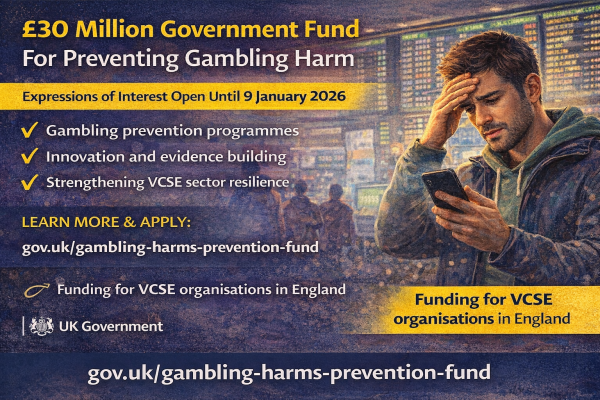
Background
The Government announced in February 2025 the Office for Health Improvement and Disparities (OHID) would become the future prevention commissioner for gambling-related harms in England, working alongside appropriate bodies in Scotland and Wales. It also announced a new statutory levy on gambling operators would take effect from 6 April 2025. This levy is expected to raise over £100 million and will be allocated across the three workstreams of research (20%), prevention (30%) and treatment (50%).
Objectives of Fund
The key objectives of the Gambling Harms Prevention VCSE Innovation Grant are to:
- Maintain and support sector to deliver on prevention... Continue reading
Background
The Government announced in February 2025 the Office for Health Improvement and Disparities (OHID) would become the future prevention commissioner for gambling-related harms in England, working alongside appropriate bodies in Scotland and Wales. It also announced a new statutory levy on gambling operators would take effect from 6 April 2025. This levy is expected to raise over £100 million and will be allocated across the three workstreams of research (20%), prevention (30%) and treatment (50%).
Objectives of Fund
The key objectives of the Gambling Harms Prevention VCSE Innovation Grant are to:
- Maintain and support sector to deliver on prevention outcomes.
- Build sector capacity and sustainability free of industry influence.
- Develop evidence and innovation.
- Demonstrate strategic responsiveness.
The funder expects VCSE organisations to be able to apply for three funding strands:
- Core Prevention Delivery Fund - this will focus on the provision of direct prevention activities to prevent or reduce gambling harms.
- Innovation and Evidence Fund - funding for new, adapted, or emerging prevention approaches.
- VCSE Resilience and Systems Capacity Fund - funding support packages to strengthen the VCSE sector’s ability to deliver sustainable prevention activities that reach intended cohorts.
Value Notes
A total fund of £30 million.
Grants are expected to range from £5,000 to £2 million.
Who Can Apply
Expressions of Interest will be accepted from voluntary, community and social enterprise (VCSE) sector organisations based and working in England.
This includes:
- Registered charities.
- Community Interest Groups
- Voluntary groups
- Social Enterprises
- Other
To be eligible, organisations will need to demonstrate the following:
- That they fall into the defined category of a third sector organisation.
- That they are intending to carry out a prevention activity under the specified categories
- Social action
- Awareness
- Education
- Campaign
- Training
- Support
- Affected others
- Gambling blocking tools
- That they can provide a theory of change to demonstrate how these services to help Government to build, evidence – based prevention services at scale in future.
- Applicants will need to demonstrate their commitment to achieving an industry free funding status for the four years leading up until 2030 and will be required to sign a Declaration of Interest agreement provided by Government.
- That they will share best practice and build partnerships across the sector.
- How they will build ‘lived experience’ into their plans.
Eligible Expenditure
The funding will support either existing work or new projects/innovation and can cover:
- Delivery (gambling prevention)
- Workforce
- Digital support / data systems
- Setting up Innovation work
- Partnership work/networks
- Other
Location
England: locally, regionally or nationally
How To Apply
Full details and the Expression of Interest form are available on the Government Grants Service (Find a Grant) website.
The deadline to submit an Expression of Interest is 9 January 2026 (12 noon).
Applicants will need to register(External link) on Find a Grant in order to apply for the grant.
Please note the following timetable is 'indicative' and could change:
- Competition window opens – 12 January 2026
- Notification of Grant Awards to successful grant applicants – 16-18 March 2026
- Payments made – from April 26 2026
- Date by which funding must be spent – 31 March 2028
Contact the Cabinet Office (OHID) for further information.
Documents & links
Contacts
For further information on how to obtain this fund, please contact the following:
-
OHID
Cabinet Office
70 Whitehall
London
SW1A 2AS
Email: ggms.ohidgamharmprev@cabinetoffice.gov.uk(External link)
Background
Grow Wild Community Funding is provided and administered by Grow Wild UK, which is the national outreach learning initiative of the Royal Botanic Gardens, Kew.
Grow Wild contributes to Kew's mission to understand and protect plants and fungi for the wellbeing of people and the future of all life on Earth.
Objectives of Fund
The funding is for groups across the UK to transform urban spaces for the benefit of people and wildlife through planting and championing UK native plants or fungi.
The funding is for projects that focus on UK native plants, transform an urban space, enhance the biodiversity of the space with planting and growing as a core activity.
Projects should be led by groups who care about the environment and will use sustainable materials and practices and have the potential to reach at least 300 people.
In addition, projects need to work with one or more of Grow Wild’s target audience:
- Young people aged 12-25.
- People experiencing some disadvantage or reduced access to services.
- People who are less engaged with others in their local community.
- People who face barriers to connecting with nature.
- Disabled people.
Project leaders will be invited to share their experiences with other successful groups and attend online events and training facilitated by Grow Wild.
Value Notes
Grants of £2,000 are available.
It is anticipated that around 23 groups from across the UK will receive funding in 2026.
Grants must be spent by the end of October 2026.
An opportunity to apply for a £500 follow-on grant for spring 2027, to help support ongoing activities.
Match Funding Restrictions
Match funding is not required.
Who Can Apply
Applications will be accepted from not-for-profit organisations in the UK, including:
- Constituted voluntary/community organisations, groups or clubs.
- Charities
- Not-for-profit companies
- Community Interest Companies (CICs)
- Charitable Incorporated Organisation (CIOs)
- Community Benefit Societies
Groups must:
- Have two members of staff or volunteers who can liaise with Grow Wild.
- Be able to deliver and be financially responsible for a community project.
- Hold a bank account in the name of their group and can show evidence of this to Grow Wild.
Restrictions
The following are not eligible for funding:
- Companies that pay profits to directors, shareholders, or members, instead of reinvesting them for charitable purposes.
- Local authorities, including parish councils, though projects led by independent groups on local authority land can be funded.
- Unconstituted organisations, groups or clubs.
- Schools.
- Projects where Grow Wild funds are to be used for commercial benefit.
- Sole traders or individuals.
- Organisations and projects based outside the UK.
- Organisational costs or staff costs that are not related to the direct delivery of the projects.
- Projects delivered in rural, conservation or protected areas such as SSSIs.
- Projects requiring planning permission, due to the programme timelines.
Eligible Expenditure
The funding can cover 100% project-specific costs:
- This can include seeds, plants, soil, materials, events, workshop charges, specialist experts and contractor costs.
- Applicants can allocate up to 25% of the Grow Wild funding value towards staff costs related to direct delivery of project activities (this can include workshop preparation and delivery, volunteer support, practical sessions).
- To pay for individuals not employed by the applicant organisation and partner organisations to deliver project activities.
Location
Urban areas across the UK
How To Apply
This is an annual grants programme.
Applications for the 2026 programme are now open with a deadline of 4 February 2026 (15:00).
Guidance notes and the application form can be found on Grow Wild's website.
Contact Grow Wild for more information.
Documents & links
Contacts
For further information on how to obtain this fund, please contact the following:
-
Enquiries
Grow Wild
Tel: 020 8332 3842
Email: hello@growwilduk.com(External link)
Background
BlueSpark Foundation is a registered charity which supports the education and development of children and young people by providing grants for educational, cultural, sporting and other projects.
Objectives of Fund
The funding is for relatively small-scale projects, which might not happen at all or would only happen on a lesser scale without the support of BlueSpark.
The Foundation aims to help children and young people reach their full potential by supporting projects that have the following objectives:
- Encouraging independence.
- Developing team working skills.
- Developing self-confidence.
- Promoting creativity and individuality.
- Encouraging aspiration.
- Enhancing educational achievement.
- Widening educational horizons.
Value Notes
Grants of up to £5,000 are available.
Awarded grants must constitute a significant proportion of the costs of the project rather than being marginally incremental to its funding.
Grants will only be awarded for the amount requested in the application and will not be scaled back to a lesser amount.
Match Funding Restrictions
Match funding is not a prerequisite. However, organisations that can raise part of the cost of a project themselves will be looked upon favourably during the application assessment, particularly where the application is for more than £2,000.
Who Can Apply
Schools, community groups, clubs, societies and other not-for-profit organisations based and working in England can apply, as can individuals.
Restrictions
The following are not eligible for funding:
- Projects for children or young people under the age of 5 or over the age of 22.
- Life-skill mentoring services.
- Counselling services.
- Holiday clubs or playgroups.
- Construction, maintenance or repair of buildings or facilities.
- Training adults who work with children or young people.
- Student fees or maintenance.
- Running costs or general activities of an organisation.
The Foundation do not normally make grants to organisations or individuals in order to enable them to provide their own services (for which they would usually charge) on a free or subsidised basis to a third party.
Grants will not be made to a single organisation on such a regular basis that they are effectively an income stream for that organisation.
Eligible Expenditure
The funding is for the costs of specific, relatively small-scale projects that might not happen at all or would only happen on a lesser scale without the support of BlueSpark.
Projects can be educational, cultural, sporting or other activities but particular consideration will be given to those that help the self-confidence, team working skills and future employability of children and young people.
Projects that the Foundation support include, but are not limited to the following:
- Academic education.
- Art and design.
- Community projects.
- Debating.
- Drama.
- Educational excursions.
- Enterprise projects.
- Music.
- Public speaking.
- Sport.
- Vocational training.
Eligible costs could include:
- Educational materials.
- Sports equipment.
- Musical instruments.
- IT equipment.
- Drama tuition.
- Music tuition.
- Art and design equipment.
- Educational training courses.
- Vocational training courses.
- Educational excursions.
- Competitions.
- Educational events.
- Seed funding for enterprise projects.
- Drama production costs.
Grant applications must state exactly what the grant will be used for, for example:
- Physical assets (such as tablets, sports equipment, or lighting for stage productions).
- Services or facilities (such as sports coaching, music or drama tuition).
- Provision of experiences (such as theatre visits).
Location
England
How To Apply
Applications can be submitted at any time and are reviewed on a rolling basis at approximately eight week intervals.
Applications should be submitted using the online application form, which is available on the BlueSpark Foundation website.
Documents & links
Contacts
For further information on how to obtain this fund, please contact the following:
-
Enquiries
BlueSpark Foundation
84A Upland Road
Sutton
Surrey
SM2 5JB
Tel: 020 8661 9997
Email: contact@bluesparkfoundation.org.uk(External link)
Background
Another Way Women’s Foundation (AWWF) is an independent, volunteer-led, grant-making charity dedicated to enabling a brighter and fairer future for women and girls through financial support, education, empowerment and advancement.
The Foundation supports impactful projects and services with the aim of accelerating gender equality, effecting system change and advancing women’s lives, sustainably, at both an individual and community level.
Objectives of Fund
The funding supports sustainable, cooperative, community-led initiatives aimed at the root cause of gender inequality (system change) in under-represented communities and/or under-funded areas.
The Foundation offers two different grants:
- Another Way Women's Foundation grants are for any type of project, initiative, service aimed at advancing and empowering women, creating positive social change, sustainably impacting communities, or indeed anything that makes the world a brighter and better place for women and girls.
- The '£1000 for 1000 words' grants provide 'seed funding' to kick start things on a project or service aimed at advancing women's lives for the better.
The Foundation has announced that from January 2026, there will be two application windows each year:
- January will be for GENERAL applications supporting women and girls in any area.
- September will be for SPECIFIC applications supporting women and girls only in the stated focus area of that year.
The focus areas will be:
- September 2026 - Sport and Leisure
- September 2027 - Environment, Eco and Sustainability
- September 2028 - The Arts
Value Notes
There are two different grants:
- Another Way Women's Foundation grants of up to £5,000.
- The '£1000 for 1000 words' grant.
Who Can Apply
UK registered charities and other not-for-profit organisations can apply.
Eligible Expenditure
All applications must be in line with and supportive of the Foundation’s charitable purpose: to enable a brighter and fairer future for women and girls through financial support, education, empowerment and advancement, and to accelerate gender equality, effect system change and advance women’s lives, sustainably, at both an individual and community level – as well as the Foundation's values and ethos – which are to be empowering and enabling, community- and people-centric, passionate and inspiring, and trusted and respectful.
The grants typically fall into two areas:
- Project support – ‘seed’ funding for pilot or start-up initiatives to show ‘proof of concept’, with a view to enabling partner organisations to go on to apply for further/larger grants from other funders to expand/increase the project scope, or to attain self-sustainability for the project.
- Services support – aid funding to enable support organisation and service providers to pay for essential service delivery.
Location
England and Scotland
How To Apply
Applications next open on 1 January 2026 and close on 30 January 2026. This round is for general applications supporting women and girls in any area.
Guidance notes and application forms can be found on the Another Way Women's Foundation website.
The Foundation aims to respond to all applications to say whether or not they have been successful within four to six weeks of the published closing date.
Successful applicants can expect to receive funds within two to three weeks from hearing that their application has been awarded.
Unsuccessful applicants may apply again.
Contact the Foundation for further information.
Documents & links
Contacts
For further information on how to obtain this fund, please contact the following:
-
Enquiries
Another Way Women's Foundation
Moss House Farm
Lowes Lane
Gawsworth
Macclesfield
Cheshire
SK11 9QR
Tel: 07841975950
Email: hello@anotherwaywf.org
-
Share November 2025 - Funding Opportunities on Facebook Share November 2025 - Funding Opportunities on X (formerly Twitter) Share November 2025 - Funding Opportunities on Linkedin Email November 2025 - Funding Opportunities link
November 2025 - Funding Opportunities
10 months ago
Macmillan Care Grants
Background
The Macmillan CARE (Culture • Agency • Respect • Equity) Grants Programme is a pilot programme provided and administered by Macmillan Cancer Support as part of its work to make cancer care better for everyone, no matter who they are or where they live in the UK.
The programme is designed to test how community-led approaches can tackle deep-rooted unfairness in cancer care. Macmillan believe community organisations understand their communities best and are best placed to drive change. This programme is a first step in the journey to re-imagine how Macmillan funds community-led work. It's a... Continue reading
Macmillan Care Grants
Background
The Macmillan CARE (Culture • Agency • Respect • Equity) Grants Programme is a pilot programme provided and administered by Macmillan Cancer Support as part of its work to make cancer care better for everyone, no matter who they are or where they live in the UK.
The programme is designed to test how community-led approaches can tackle deep-rooted unfairness in cancer care. Macmillan believe community organisations understand their communities best and are best placed to drive change. This programme is a first step in the journey to re-imagine how Macmillan funds community-led work. It's a learning opportunity for everyone involved, designed to help Macmillan test new approaches without the pressure of strict targets. Future programmes will build on this learning to support the introduction of larger, longer term funding opportunities.
Objectives of Fund
The funding is for community-led projects that challenge the current system and create lasting change for people facing the greatest barriers to care.
Projects should offer new insights and impact and focus on one of the following three themes:
- Cultural Responsiveness in Cancer Care - projects that help healthcare services better understand and meet the cultural needs of different communities and remove barriers to person-centred care.
- Shared Decision-Making - projects that make it easier for people to understand their treatment options, take part in decisions about their cancer care, and reduce unfair differences in how this happens.
- Dementia-Friendly Cancer Care - projects that support people living with both cancer and dementia, improve their care experience, and help them and their carers take part in treatment decisions.
Value Notes
Up to £1.5 million is available for this first round, with grants ranging from £50,000 to £150,000. Grants are for either one or two years.
Who Can Apply
Application will be considered from voluntary, community, faith or social enterprise (VCFSE) organisations based in the UK, including:
- Registered charities
- Charitable Incorporated Organisations (CIOs)
- Community Interest Companies (CICs)
- Companies Limited by Guarantee
- Faith-based organisations
- Residents/tenants association and community groups
- Local sports clubs and Recreational/Social clubs
- Community benefit societies
To be eligible, applicants must:
- Be UK based (England, Scotland, Wales or Northern Ireland).
- Have governance appropriate to their size and the grant they are applying for (minimum three unrelated trustees/directors and two unrelated bank signatories)
- Show experience addressing health inequities or working as a trusted partner with communities facing barriers to cancer care
- Be able to deliver the project within the grant timeframe (grants are for either one year or two years)
- Demonstrate community-led, co-designed approaches
- Show how their project will make a difference for people living with cancer.
Restrictions
The following are not eligible for funding:
- Informal support groups without a legal structure (unincorporated groups)
- Unregistered charities
- CICs that distribute dividends to private shareholders
- Individual healthcare professionals
- NHS trusts or hospitals
- Local authorities or government bodies
- Commercial businesses and sole traders
- Political lobbying
- Costs that should be covered by statutory funding
- Retrospective activities
- Core costs beyond 15% of the project budget
- Pre-diagnosis cancer care activities
A full list of restrictions can be found in the information pack.
Eligible Expenditure
The funding is for community-led and co-designed projects that meet at least one of the three key themes and:
- Are designed by and with the people most affected.
- Have clear leadership and understand what partnerships are needed for success.
- Have the capacity to create change with clear goals, good plans and an understanding of the wider context they are operating in.
Grants will support:
-
Staff and People costs:
- Salaries for project staff (including recruitment costs)
- Freelance trainers, facilitators and consultant
- Fees for experts by experience and community facilitators
- Training and supervision for project staff
-
Project delivery costs(examples of possible activities):
- Training design and delivery
- Reverse mentoring programmes
- Action research and testing new approaches
- Awareness-raising or promotional activities that aim to influence change
- Partnership development with NHS, social care or other organisations
- Co-design workshops with communities
- Resource development (materials, tools, accessible formats)
- Venue hire, equipment hire, refreshments
- Project overheads (e.g. public liability insurance)
- Accessibility accommodations (BSL interpreters, transport, etc.)
-
Evaluation and learning costs:
- Impact assessment tools and data collection
- Evaluation support (internal or external)
- Report writing and documentation
- Peer learning events and networking
- Conference attendance
Full details are in the application information pack.
Location
UK
How To Apply
The deadline for applications is 23 January 2026 (17:00). Decisions are expected in early to mid March 2026.
All relevant documents and the online eligibility quiz can be found on the Macmillan Cancer Support website.
Macmillan is providing three information webinars that will cover not only the Macmillan CARE Grant but also other Macmillan grants currently available for community applicants:
- 2 December 2025 (11:00am – 12:00pm). Registration is required.(External link)
- 11 December 2025 (18:00 - 19:00) Registration is required(External link)
- 8 January 2026 (15:30 - 16:30) Registration is required.(External link)
Pre-application support calls are also available.
Contact Macmillan Cancer Support for further information.
Documents & links
Contacts
For further information on how to obtain this fund, please contact the following:
-
Macmillan CARE Grants Programme team
Macmillan Cancer Support
89 Albert Embankment
London
SE1 7UQ
Tel: 020 7840 7840
Email: CommunityGrants@macmillan.org.uk(External link)
Barclays Community Sport Fund - Female Coaches for Girls Fund
Background
The Barclays Community Sport Fund, delivered in partnership with Sported, aims to reduce inequalities in sport – with a focus on football, tennis, and cricket.
The three year funding programme, running from April 2025 to December 2027, will provide £1.4 million each year.
Objectives of Fund
The funding supports community groups and grassroots sports organisations who are working within the most deprived areas of the UK and are making sport more accessible to women and girls, as well as engaging people from other under-represented groups including people with disabilities, from racially diverse communities and from the LGBTQ+ community.
Currently only the Female Coaches for Girls Fund is open for applications with a deadline of 31 December 2025.
Value Notes
The programme offers:
-
Female Coaches for Girls Grants to support football, tennis, and cricket coaching courses to help increase the number of female coaches delivering sport to girls. Two coaching grants per club to cover the cost of, or a contribution towards, a Level 1 or equivalent introductory qualification and any additional safeguarding and first aid requirements for the chosen sport. This is to upskill up to two female coaches at the club or group.
- Level 1 coaching grants: Football - £160 grant; Tennis - £200 grant; Cricket - £200 grant.
The Fund also offers:
- Exclusive match tickets, mascot places, and promotional opportunities.
- Access to advice and support and signposting to training and resource.
Who Can Apply
Applications will be accepted from not-for-profit organisations including community groups, youth groups and traditional sports clubs.
To be eligible, applicants must:
- Deliver football, cricket, or tennis activities for women and girls – or are applying for funding to start.
- Operate in an area of high deprivation. The Government Indices of Multiple Deprivation (IMD) are used to establish eligibility and only organisations located in or supporting people from IMD areas 1-3 are eligible to apply.
Disability applications from groups that sit outside of IMD areas 1-3 will be considered as long as they groups offer activities for women and girls.
Restrictions
The following are not eligible for funding:
- Trips abroad.
- Costs associated with elite football or talent development.
- Talent development.
- Schools and other educational institutions. (Charities that support schools may be considered if they are inclusive of young people from the wider community and not just pupils from that school.)
- School curriculum-based activities.
Eligible Expenditure
The funding is unrestricted and can be used for anything that will support delivery of football, cricket, or tennis activities for women and girls.
Typical examples of costs might include a contribution towards:
- Venue hire including floodlights and heating.
- Coaching costs
- Volunteer expenses
- Equipment
- Kit
- Marketing and communications
- Training and qualifications
- Insurances and affiliation.
Ideally the funding should be spent within a six month period.
Location
UK
How To Apply
The female coaches for girls fund remains open until 31 December 2025.
The FAQs, application guidance, and online application form can be found on the Sported website.
Groups who are not a Sported member or existing grantee will need to create an account to start their application.
Please note it is anticipated that the fund will be 'extremely popular' and thus applications may close earlier than the deadline. Groups should apply early to avoid disappointment.
Contact Sported for further information.
Documents & links
Contacts
For further information on how to obtain this fund, please contact the following:
-
Sported Team
Sported Foundation
House of Sport (4th Floor)
190 Great Dover Street
London
SE1 4YB
Tel: 0203 848 4670
Email: barclays@sported.org.uk(External link)
Background
Established in 1960, the Bernard Sunley Foundation is an independent grant-making charity that offers financial assistance to registered charities for a wide range of purposes.
Objectives of Fund
The aim of the foundation is to help raise the quality of life in England and Wales, particularly for the young, disadvantaged and older people.
Value Notes
The Foundation offers three levels of grants:
- Large grants of £25,000 and above.
- Medium grants up to £20,000.
- Small grants of £5,000 and under.
Grants are for capital projects of between £10,000 and £5 million.
Match Funding Restrictions
The foundation does not offer match funding. Grants are rarely more than 20% of the total budget. The foundation will very rarely fund the full costs (or even 50%) of a project or shortfall as it expects to be one of many contributors to a project.
Who Can Apply
Applications will be accepted from the following types of organisations with an annual income of less than £10 million:
- Charities registered in England and Wales
- Charitable Incorporated Organisations (CIOs) working in England and Wales
- Specialist schools
- Scout and guide groups
- Housing associations.
- Cooperatives and community benefit societies registered with the FCA (Financial Conduct Authority).
Applications are considered from all areas of England and Wales, particularly from rural and isolated communities.
Restrictions
The following are not eligible for funding:
- Charities registered outside England or Wales.
- Community amateur sports clubs (CASCs).
- Community interest companies (CICs).
- Unregistered community groups/clubs.
- Town and parish councils.
- Churches or other religious bodies with no or limited secular activity.
- NHS hospitals or charities fundraising on their behalf.
- Mainstream schools, colleges or universities, or charities fundraising on their behalf.
- Charities with an annual income of £10 million and over.
- Charities with an annual income of £1 million and over applying for a project costing less than £100,000. Special Educational Needs schools are excepted.
- Newly established charities with no previous annual accounts.
- Charities that have applied to us unsuccessfully within the previous 12 months.
- Charities applying for a new grant before an existing pledged grant has been paid.
- Individuals
- Project costs of over £5 million.
- Project costs of less than £10,000.
- Equipment such as IT infrastructure and AV systems, work tools, sports gear, musical instruments etc.
- Fittings such as electrical appliances and furniture.
- Church towers, bells or organs.
- Second hand vehicles.
- Capital fees – building surveys, planning applications or feasibility studies.
- Core costs – salaries, running and repair costs, websites and other IT, programmes, rent, utility bills.
- Heritage or conservation projects with no or limited community benefit.
- Medical or research medical equipment.
- Solar panels and/or battery storage (unless it is part of a wider project).
Following an application, organisations should not reapply for at least 12 months (from the date of the original application).
Eligible Expenditure
The funding is for one-off capital projects (not running costs) that fit into one of the following themes:
Community - projects should make a positive contribution to their neighbourhood and create a sense of belonging. These projects provide greater opportunities for families, the elderly, young people and children to get involved in sport and social activities. Churches are considered if their improvements benefit the wider community.
Community funding areas
- Churches
- Community Centres
- Rescue Services
- Sport
- Uniformed Groups
- Village Halls
- Youth Clubs
Health - projects need to provide an excellent standard of care and support in their communities. These include the creation of modern facilities for those suffering from a range of illnesses such as cancer, mental health or neurological conditions. They also include developing amenities such as gardens and outdoor spaces that provide relief and sanctuary for patients, their families and carers.
Health funding areas
- Animal Assisted Therapy
- Cancer
- Day Services for Disabled
- Hospices
- Medical Aid Overseas
- Mental Health
- Neurological
- Residential for Disabled
- Sight/Hearing Loss
Social Welfare - funding to assist the most vulnerable in society such as those seeking help with addiction, homelessness, ex-offenders and victims of domestic and sexual abuse.
Social welfare funding areas
- Animal Welfare
- Addiction and Rehabilitation
- Almshouses
- Armed Forces and Veterans
- Domestic and Sexual Abuse
- Elderly
- Ex-Offenders
- Homeless
- Poverty Relief Overseas
- Social Enterprises
Education - funding supports learning experiences and life skills for children and young people, particularly for the disadvantaged, those with disabilities or special needs. There is particular interest in projects that encourage young people to experience the outdoors and to try new pursuits.
Education funding areas
- Arts
- Countryside
- Literacy
- Music
- Outdoor Learning
- Special Needs Schools/Colleges
Location
England and Wales
How To Apply
The first step in the application process is to complete the online eligibility check. Those who are successful will be able to access the online application form.
Large and medium grant applications are considered at the Trustees’ meetings held in March, July and November.
Small grants are decided by Trustees on a monthly basis.
Contact the Bernard Sunley Foundation for further information.
Documents & links
Contacts
For further information on how to obtain this fund, please contact the following:
-
Enquiries
Bernard Sunley Foundation
Green Park House
15 Stratton Street
London
W1J 8LQ
Tel: 020 3036 0090
Email: office@bernardsunley.org

-
Community Resilience Lead Officer
JR -
Team